When the student's current MSN pathway or course requires a preceptor, mentor, or practicum site, University of California, Los Angeles students may ask us to search for a candidate that fits the requirements they confirm. The program approves or declines every proposal, and directory inclusion should not be read as a statement of school policy.
The directory record answers one narrow question: why University of California, Los Angeles belongs in this MSN roster. It cannot establish concentration availability, modality, mentor qualifications, state authorization, hour requirements, or the institution's placement process. Confirm each of those points directly for the student's catalog year.
As of the July 21, 2026 source review, CCNE records supported an accredited master's nursing degree at University of California, Los Angeles. That is a useful verification point but a limited one. It cannot be used to infer available specialties, delivery method, field-experience hours, approval deadlines, mentor rules, or placement assistance.
A useful request begins with a current requirement packet. Confirm the pathway, course purpose, term, location limits, expected setting, supervisor qualifications, disallowed relationships, compliance steps, affiliation process, and approval deadline. If the program has not confirmed that a field experience applies, do not assume one from the MSN degree name.
A direct-care pathway can make the clinical population and supervisor's certification central to site fit. The program may need evidence of current licensure, board certification, active practice, relevant patients, adequate supervision, and a compliant setting. Apply that screen only after University of California, Los Angeles confirms the actual pathway and course requirements for the student.
An educator course and a leadership course ask different questions of a proposed mentor. One may focus on teaching environments, curriculum, simulation, or staff development; the other may focus on operations, quality, administration, or executive work. Only current University of California, Los Angeles materials can establish whether either pathway exists and what qualifications apply.
The word practicum can describe very different work. Informatics may involve technology and workflow; public or community health may involve population initiatives; quality, care coordination, and clinical nurse leader work may sit in other systems settings. The MSN pathway guide explains these distinctions without claiming that University of California, Los Angeles offers all or any of them.
MSN practice requirements cannot be reduced to one reliable number. Hours vary with the program, pathway, course, and catalog year, and some courses may use field experiences that differ in purpose. Ask University of California, Los Angeles to confirm the student's current requirement in writing, then use that answer rather than an online comparison or a figure from another pathway.
Read how MSN practicum hours vary, then verify the active course with University of California, Los Angeles. Sourcing should begin only after the program confirms the amount, experience type, approved geography, supervisor role, setting, and forms attached to the requirement.
Start the geographic plan with the student's authorized location, not an assumption drawn from University of California, Los Angeles's Los Angeles address. The program may apply state, site, licensure, affiliation, or modality rules that the accreditation source does not show. Every proposed setting still needs course fit and program approval.
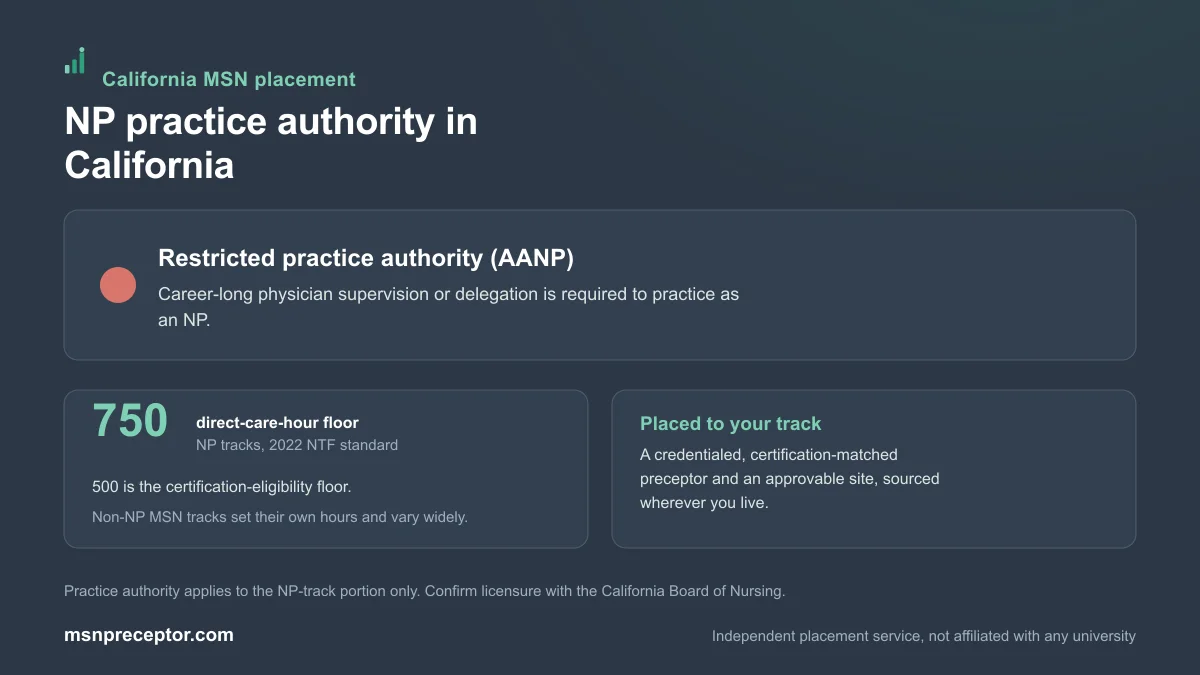
Our California MSN guide gives a state-level view of possible practice and systems settings. The school page and state page are planning aids; the current program still decides whether the student's location, candidate, site, and documents are acceptable.
Candidate willingness is only the beginning. An approval packet should explain the role, credentials, setting, relevant work, supervision, availability, course alignment, and paperwork status. The program can then apply its current affiliation, compliance, authorization, conflict, site, and mentor rules without relying on unstated assumptions.
Before a candidate is contacted, verify the pathway, course, practicum purpose, hours, term dates, location authorization, eligible setting, supervisor role, required license or certification, experience standard, affiliation process, compliance checklist, forms, conflicts, and school deadline. A missing requirement can change who or what counts as a useful match.
Independent support is most useful after the student turns the current handbook and course instructions into a precise request. See how sourcing works, then use the request form with the course, pathway, location, setting, role, dates, and approval documents the program supplied.
MSNPreceptor works independently of University of California, Los Angeles and does not speak for its nursing program. Candidate sourcing is not school approval. We cannot guarantee availability, placement, affiliation completion, acceptance, course progression, or any other result, and the institution applies its own current rules.
It applies when the student's current MSN pathway or course requires a preceptor, mentor, or practicum site and the student has the current requirements needed for sourcing. University of California, Los Angeles makes every approval decision.
No. The accreditation evidence establishes an accredited master's nursing degree on the verification date. It does not prove an NP concentration, education, leadership, informatics, public health, or another pathway, and it does not establish modality or placement policy.
There is no universal MSN practicum total. Required hours vary by program, pathway, course, and catalog year. Confirm the current handbook, degree audit, course instructions, and field placement office rather than relying on a generic number.
The answer follows the confirmed pathway and course. Direct-care NP, education, leadership, informatics, public health, quality, and other experiences can require different professionals and settings. The current program must approve the proposed role, credentials, site, and paperwork.
No. MSNPreceptor is an independent service that works separately from University of California, Los Angeles. We source and document possible candidates for program review and do not guarantee placement or approval.
Last updated July 2026. Sources: University of California, Los Angeles website; CCNE accredited program evidence; AACN The Essentials.
No cost to request. An advisor reviews the current course, pathway, location, and approval requirements before candidate sourcing begins.
We do not guarantee placement. Final approval rests with your program.
