The honest answer in 2026 is a moving target: somewhere between roughly 585 and 750 direct-care hours for most online NP tracks, because the national standard is mid-transition. Here is what is changing, what counts, how programs package the hours into courses, and how to read your own catalog's number without getting burned.
Nurse-practitioner education is governed by the National Task Force (NTF) on Quality Nurse Practitioner Education. Its 5th edition (2016) set a minimum of 500 supervised direct patient-care clinical hours. The 6th edition, published in 2022, raises that floor to 750 direct-care hours.
That change is being phased in over several years, which is why programs legitimately differ right now. A school still listing 585, 600 or 640 is not cutting corners; it is meeting accreditation at the prior benchmark while it transitions. The direction of travel, though, is clear: 750 is becoming the standard, and several large online programs already sit exactly on it.
One rule does not move: the hours must be direct patient care. Simulation and skills-lab time build competence but do not count toward the NTF minimum, at either the old or the new floor. That matters when you compare programs, because a catalog that folds lab or simulation time into a bigger headline number is describing something different from the precepted, direct-care total your certification body cares about.
The practical consequence is course-specific: when your current program requires you to propose a qualified preceptor and site, each approved hour needs the supervision and documentation defined for that course. Confirm the current process before sourcing, then use our complete MSN school directory for an approval-focused planning page.
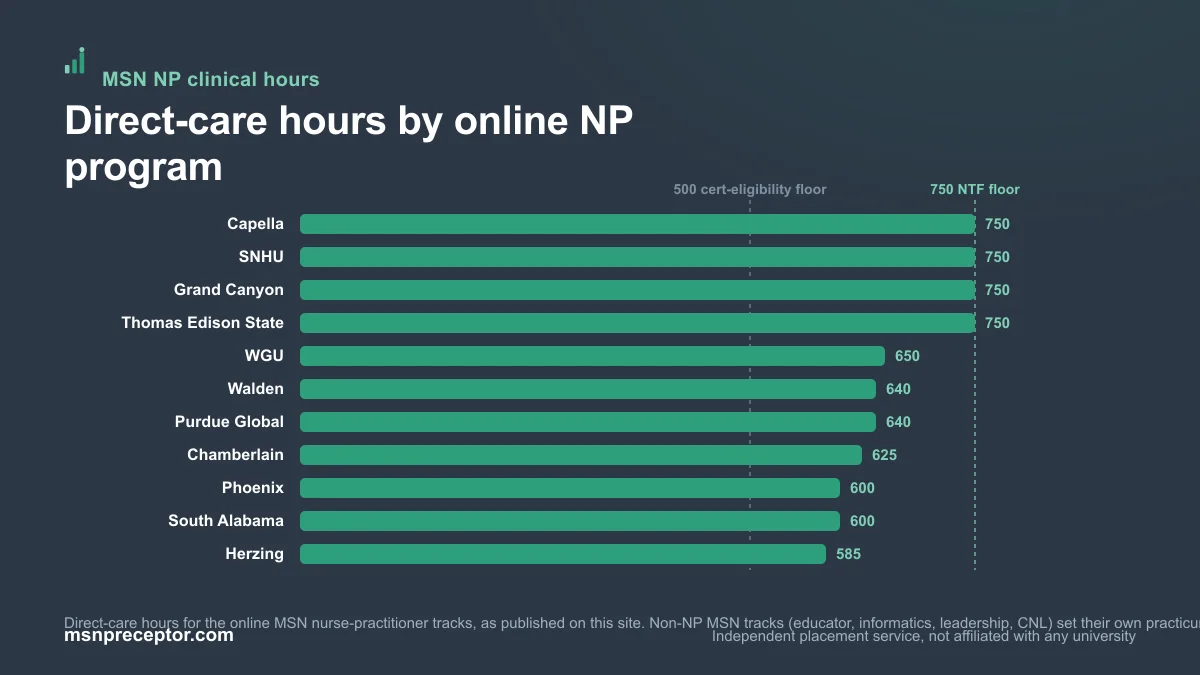
These are the published direct-care figures for the NP tracks we are asked about most. Confirm your own number against your current catalog, because programs revise them as they adopt the 2022 Standards, and the number that binds you is the one in force for your enrollment.
| Program | MSN NP track | Direct-care hours |
|---|---|---|
| Capella | MSN-FNP | 750 |
| SNHU | MSN-FNP | 750 |
| Grand Canyon | MSN-FNP | 750 |
| Thomas Edison State | MSN-FNP | 750 |
| WGU | MSN-FNP / PMHNP | 650 |
| Walden | MSN-FNP | 640 |
| Purdue Global | MSN-FNP | 640 |
| Chamberlain | MSN-FNP | 625 |
| Phoenix | MSN-FNP | 600 |
| South Alabama | MSN-NP | 600 |
| Herzing | MSN-FNP / PMHNP | 585 / 540 |
Read the spread for what it is: the schools at 750 have already adopted the new NTF floor, and the schools between 540 and 650 are certifying against the earlier benchmark while they transition. Neither group is doing anything wrong, but the difference changes how many preceptor-months you personally need to line up.
Most programs divide the practicum total into a sequence of clinical courses rather than one long block, and the two clearest published examples are a 640-hour track built as four 160-hour practicum courses and a 625-hour track built as five 125-hour courses. The first is Walden's NP structure; the second is Chamberlain's FNP sequence.
The packaging matters more than students expect. A course-based split usually means per-course paperwork: your preceptor and site are approved for a specific course and term, and a new course can mean a fresh approval cycle, sometimes a fresh preceptor. It also means capacity math. A preceptor who can host you for one 125-hour course may not be able to carry you through five of them, so the real question is never just who will precept me, it is who can precept me for this course, this term, at this hour load.
When we source a match, we plan against the course sequence, not just the headline total, so a mid-program handoff is a scheduled event rather than a scramble. How that planning works step by step is on our how it works page.
Yes, and sometimes by more than a hundred hours. At Purdue Global the MSN-FNP requires 640 direct-care hours while the AGACNP track requires 520. At Herzing the FNP totals 585 hours while the PMHNP totals 540. Same university, different tracks, different totals.
The reason is that each population focus carries its own competency map. An FNP has to demonstrate care across the whole lifespan, from pediatrics through geriatrics, which simply takes more precepted exposure than a track scoped to one population or one setting. Acute-care and psychiatric tracks concentrate their hours in narrower, harder-to-source settings instead.
For you this cuts two ways. A lower total does not mean an easier placement: 540 psychiatric hours are usually harder to source than 750 primary-care hours, because the qualified-preceptor pool is so much smaller. What each specialty actually needs from a preceptor is covered on our specialties page.
If your MSN is not a nurse-practitioner degree, the hour picture changes entirely. Leadership, education and informatics tracks require a practicum tied to a project and a qualified mentor, not hundreds of direct patient-care hours. Capella's non-NP MSN practicum runs about 100 hours, Aspen's about 120, and Thomas Edison and American College of Education land near 200.
It helps to see the whole ladder at once. A typical RN-to-BSN capstone practicum is small, about 40 hours in Grand Canyon's NRS-465 course, for example. Non-NP MSN practica run roughly 100 to 200 hours. NP tracks run 540 to 750 direct-care hours. And a post-master's DNP builds to 1,000 post-baccalaureate hours, with your MSN NP hours counting toward that total. Each rung roughly triples the footprint, and the preceptor search scales with it.
You still typically arrange a non-NP practicum site yourself, but the ask is a mentor and a project home rather than a certifying clinical supervisor, and placements move faster as a result.
The direct answer: supervised direct patient care counts, and almost nothing else does. Before you count on any specific arrangement, run it against these rules.
Logging is part of counting. Schools run their practicum hours through tracking systems, and the discipline they expect is real: at one large online program, students are told to document clinical hours in the school's online activity tracker within 48 hours of the experience, after which the preceptor verifies them in a companion app and faculty review the record. Whatever system your school uses, log as you go. Hours that were worked but never verified are the most painful kind to lose.
It is moving from 500 to 750. The 2016 NTF Standards set 500; the 2022 6th edition raises it to 750, phased in over several years. In 2026 online programs sit between roughly 540 and 750 depending on school and track. Check your current catalog for the exact figure.
No. The NTF direct-care minimum must be met with supervised direct patient-care hours. Simulation does not substitute at either the old or the new floor.
Most programs break the total into a course sequence. Walden's 640-hour NP practicum runs as four 160-hour courses, and Chamberlain's 625-hour FNP runs as five 125-hour courses. Each course usually carries its own preceptor approval and paperwork, so plan the sequence, not just the total.
Because each population focus has its own competency requirements. Purdue Global lists 640 hours for the FNP and 520 for the AGACNP; Herzing lists 585 for the FNP and 540 for the PMHNP. Fewer hours does not mean an easier search, since specialty preceptors are scarcer.
Because the 750 floor is being adopted on different timelines. Two accredited programs can legitimately list different numbers during the transition. The gap closes as schools move to the 2022 Standards.
No cost to request. An advisor reviews the current course, pathway, location, and approval requirements before candidate sourcing begins.
We do not guarantee placement. Final approval rests with your program.
