For Master of Science in Nursing students anywhere in California, our desk helps arrange the practicum your track requires, from a direct patient care preceptor for a nurse practitioner focus to a qualified mentor for education, informatics, leadership, or public health. California is a large and competitive state for clinical placements, and its practice rules are in transition under Assembly Bill 890, which makes local knowledge useful. We are independent, we work with students at any university, and we help without ever guaranteeing a site or a school's approval.
The Master of Science in Nursing is an umbrella over many roles, and the practicum you need depends on your track rather than your school. Some students spend every hour in direct patient care; others sit with a systems team or a nurse executive. Across California we place the whole range:
Not sure how your track translates into a preceptor? Our MSN specialties page walks through each one.
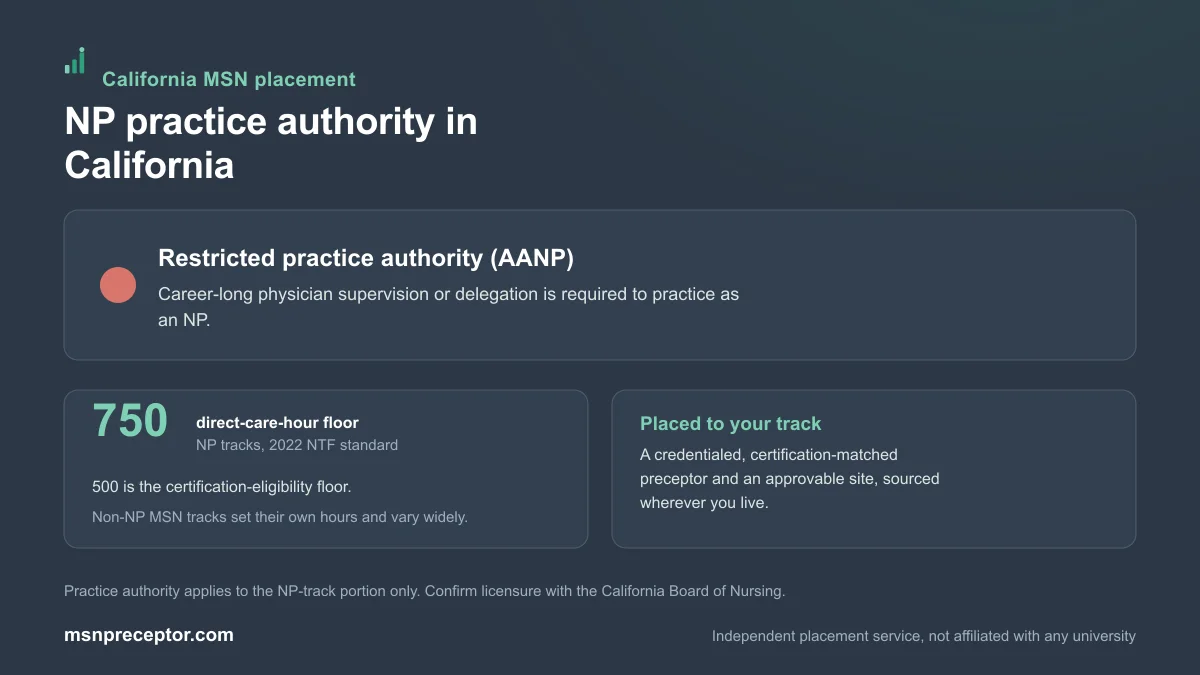
California is a restricted practice state in the American Association of Nurse Practitioners classification, meaning most nurse practitioners work under standardized procedures with a physician relationship. Assembly Bill 890 created a transition pathway toward independence: a qualified nurse practitioner who completes a defined period of clinical practice can move into a category that allows practice without standardized procedures in certain settings, and a further category opening in 2026 allows fully independent practice for those who qualify.
For a student, the practical effect is that your preceptor site may operate under standardized procedures, which shapes how supervision is documented. It does not change the hours your program requires. Because these categories are new and still rolling out, confirm the current rules with the California Board of Registered Nursing before you rely on them.
Every placement has to match the role. A nurse practitioner student needs a board certified nurse practitioner in the same population focus, or a physician, holding an active California license and delivering direct patient care. A nurse educator student needs an experienced faculty member or staff development leader; an informatics student needs a working informaticist; a leadership student needs a nurse executive; a clinical nurse leader student needs a unit based leader. The setting alone is not enough, the mentor has to hold the right role.
Hours track the type of program. Nurse practitioner tracks require direct patient care, and the 2022 National Task Force standards recommend a minimum of 750 hours, while national certification generally requires at least 500 faculty supervised hours, with accredited programs often publishing totals between roughly 500 and 750 or more. Non practitioner tracks are much lighter, commonly around 100 to 200 hours. Simulation is excluded, and you should confirm your own program's figure.
Because single specialty services cover family or psychiatric placement, the tracks that get overlooked are the non clinical ones, and those are central to what we do. A nurse educator practicum sits inside a school of nursing, a community college nursing program, or a hospital education department. An informatics practicum places you with the analytics or clinical systems team behind the electronic health record. A leadership practicum shadows a chief nursing officer or an operations leader, and a clinical nurse leader practicum works within unit coordination.
These mentors are experienced nurses in the role rather than prescribers, and the hours are lighter. In California the constraint is usually competition and geography, since informatics and executive settings concentrate in the big health systems and fill quickly.
California's scale means region matters. Greater Los Angeles and Orange County hold an enormous share of hospital systems, academic medicine, informatics teams, and executive leadership. The Bay Area adds major academic health systems and a dense health technology sector, San Diego anchors the south with large integrated systems, and Sacramento serves the capital region. The Central Valley, the Inland Empire, and the far north round out the map with growing systems and real preceptor need.
Direct patient care sites for nurse practitioner students exist across all of these regions, though demand is high and preceptors fill early, especially in the coastal metros. Informatics and leadership practicum cluster where the analytics and executive functions sit, largely the major urban systems and the technology corridor. Educator placements follow the many universities and community colleges. When a nearby match is scarce, our desk widens the radius and works the surrounding region.
We open with a short intake on your track, required hours, timeline, and region, then approach preceptors and sites that fit and confirm they can supervise a student in your specialty. As an independent service we work for students at any university, including online programs based outside California. We help with the match and the paperwork handoff, and we are honest that we cannot guarantee a placement or your program's approval of a preceptor or site.
When you are ready, tell us about your rotation on our contact page, look over how it works, or begin at the match form.
No. AB 890 changes what experienced, qualified nurse practitioners may do independently over time. Students still need a qualified, California licensed preceptor for every direct care hour, and a role based mentor for non practitioner tracks.
It can be competitive, especially for direct care sites in the coastal metros, because demand is high. That is exactly where an organized search helps, and we widen the radius across regions when local preceptors are full.
It depends on your track and program. Nurse practitioner tracks commonly run from about 500 to 750 or more direct care hours, while educator, informatics, and leadership tracks often fall near 100 to 200. Confirm the exact total with your own program.
Yes. We are independent and place students at any university, including distance programs, provided we can meet your school's preceptor and site requirements in California.
No. We work to find and confirm a suitable match and support the paperwork, but final approval rests with your program, and we never promise an outcome.
Last updated July 2026. Sources: California Board of Registered Nursing; California BRN, AB 890 News Release; California Legislative Information, AB 890; AANP State Practice Environment.
No cost to request. An advisor reviews the current course, pathway, location, and approval requirements before candidate sourcing begins.
We do not guarantee placement. Final approval rests with your program.
