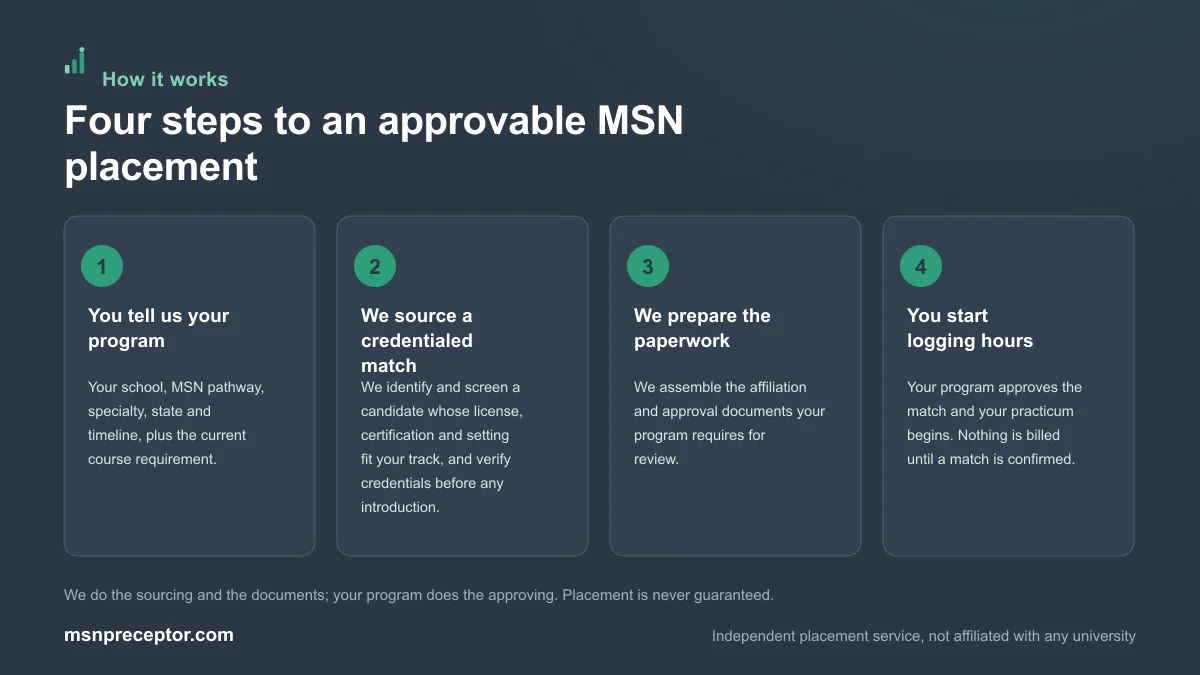
Four steps from admitted to cleared: you tell us your program, we source a credentialed match, we prepare the approval paperwork, and you start logging hours. We do the sourcing and the documents; your school does the approving. Nothing is billed until a match is confirmed, and the earlier you start, the more of the calendar works in your favor.
We start with the specifics: your school, your NP specialty, your state, when your next clinical course begins, and the direct-care hour total your catalog requires. Those five facts define the entire search, because a Capella FNP practicum at 750 hours, a Purdue Global AGACNP at 520, and a Herzing PMHNP at 540 are three different placement problems wearing the same MSN label.
We also map your program's approval machinery before sourcing begins. Some schools route everything through a dedicated field-experience office that must clear your site and preceptor. Some run fixed application windows with hard deadlines. Some approve course by course, so a 640-hour track built as four 160-hour courses needs a plan for four approvals, not one. Knowing which kind of program you are in tells us how much calendar to protect.
If you do not know your exact requirement yet, that is fine. Pinning it down with you is part of the first conversation, and our school-by-school guide covers most of the programs we see.
We identify a preceptor in your specialty and state whose credential authorizes supervision in your track, at a site whose setting fits your certification and your required hours. We verify licensure and credentials before we bring a match to you, because an unapprovable preceptor helps no one.
Verification is the unglamorous heart of this step. We confirm the license is active and unencumbered, the credential matches your track's supervision rules, the setting matches your certification, and the site actually has capacity for your course's hour load in your term. A willing preceptor who fails any of those tests would burn weeks of your approval window and then bounce, so we screen them out before you ever hear a name.
Thin-market specialties take longer, and we say so up front. Psychiatric, pediatric and women's-health preceptors are the scarcest pools, which is precisely why starting before your clinical term matters more in those tracks.
Affiliation agreements, site information forms, preceptor CVs and license documentation: we assemble the package your program's clinical office requires and shepherd it through review. Final approval always rests with your school; our job is to make saying yes easy.
Respect the timelines here, because they are longer than most students expect. Walden, as one published example, opens practicum applications in its online system, sets the deadline about three months before the term, begins review roughly three months out, and states that review can take up to three months once it starts, with any application not approved by the Friday before the term closed outright. Not every school is that formal, but every school has a version of the same clock.
Expect an insurance line item too. Many programs require students to carry their own professional liability policy for the practicum; one program's manual specifies at least 1 million dollars per incident and 3 million aggregate, covering the entire practicum term. Confirm your school's exact requirement in its handbook and get the certificate issued early, because a missing insurance page can stall an otherwise finished application.
Once approved, you log direct-care hours toward your total in whatever tracking system your school runs. Log as you go: one large program tells students to document hours in its online activity tracker within 48 hours of each clinical experience, after which the preceptor verifies the entry and faculty review it. Hours that were worked but never verified are the easiest ones to lose.
We stay on file as backup. If a site falls through mid-term, we move to re-source rather than leaving you to restart the search alone, and because we planned against your full course sequence in step one, the replacement search starts from a warm map instead of a blank page.
Five things cause most delays, and every one of them is preventable.
Our paperwork pass in step three exists to catch all five before your school ever sees the file.
Before your practicum term, and ideally well before: some programs explicitly encourage students to begin the practicum process as early as possible, with applications opening a few terms ahead, and the formal review windows above show why. As a working rule, start the conversation two terms before you need to be in clinic for primary-care tracks, and earlier for psychiatric, pediatric and women's-health placements.
Starting early costs you nothing with us, since requesting is free and nothing is billed until a match is confirmed and approved. Starting late costs exactly what you fear: a term. The pricing page explains the fee structure, and the request form below starts the clock in the right direction.
It varies by specialty and state. Primary-care FNP matches move faster than PMHNP or pediatrics in thin markets, and school review adds its own weeks or months on top: one program publishes that its review can take up to three months once it begins. Start before your clinical term, not during it.
Your school, always. We source and prepare the documentation, but the clinical office at your program makes the final decision. We never present placement as guaranteed.
Typically an affiliation agreement with the site, a preceptor commitment form, the preceptor's CV and license details, site information forms, and often proof of your own professional liability insurance. Requirements vary by program, so we assemble against your school's specific checklist.
Many programs require it for the practicum even if your employer carries coverage. One program's manual specifies a policy of at least 1 million dollars per incident and 3 million aggregate covering the entire term. Confirm the exact requirement in your school's handbook.
We re-source. A mid-term site loss is exactly what our backup role exists for, so you are not restarting alone.
Last updated July 2026. Sources: NCSBN nursing education, clinical supervision and preceptor standards; CCNE accreditation of graduate nursing programs.
No cost to request. An advisor reviews the current course, pathway, location, and approval requirements before candidate sourcing begins.
We do not guarantee placement. Final approval rests with your program.
