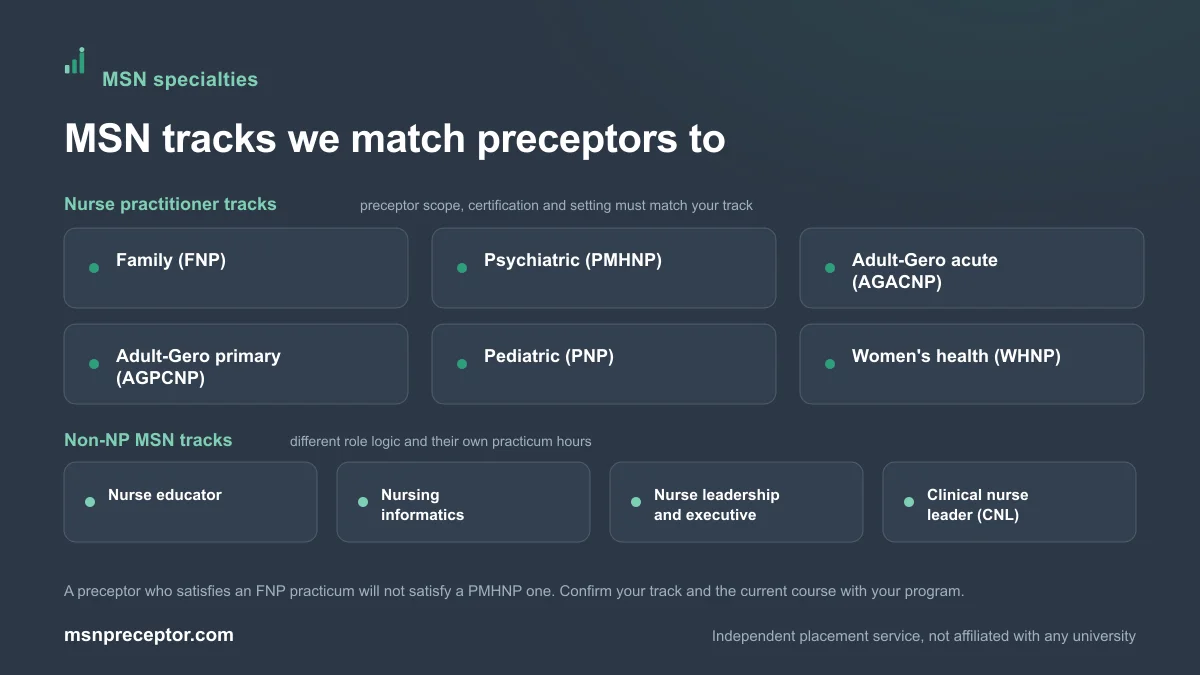
A preceptor who satisfies an FNP practicum will not satisfy a PMHNP one. NP placement is a matching problem where scope, certification and setting all have to line up with your track, and the hour totals themselves shift by specialty, from 520 at one school's acute-care track to 750 at the programs already on the new national floor. Here is what each specialty needs.
The highest-volume MSN track and the heaviest direct-care load. Published FNP totals at the online programs we work with run from 585 hours at Herzing through 600 to 650 at Phoenix, WGU and their peers, up to 750 at Capella, SNHU, Grand Canyon and Thomas Edison State. FNP practicum needs primary-care preceptors across the lifespan, from pediatrics through geriatrics, which is why FNP students often need more than one site and more than one preceptor to complete their hours.
The fastest-growing specialty and the most placement-constrained. PMHNP hours require a psychiatric-qualified preceptor for medication management and therapy, a far smaller pool than primary care. Totals vary by school just as FNP totals do: WGU lists 650 hours for its PMHNP and Herzing lists 540. Do not read the lower number as an easier search; a 540-hour psych placement is routinely harder to source than a 750-hour primary-care one, and this is the track where a sourcing service most often changes the outcome.
Certification dictates setting. AGACNP hours belong in inpatient acute care; AGPCNP hours belong in a primary-care clinic. The totals can also sit below the FNP at the same school, as at Purdue Global where the AGACNP requires 520 direct-care hours against 640 for the FNP. Matching the wrong setting to the wrong certification is one of the most common reasons a proposed preceptor is rejected at approval, and it is an unforced error we screen out before a match ever reaches you.
The narrowest specialty pools. Pediatric and women's-health preceptors are geographically thin outside major metros, and the sites that host them, pediatric practices, school-based clinics, OB-GYN and midwifery practices, tend to take fewer students per year than general primary care. This is exactly where a sourcing service earns its keep, because cold-calling a thin market is the slowest possible way to find the one slot that exists.
Not every MSN is a nurse-practitioner degree, and the practicum footprint is a fraction of an NP track. Capella's non-NP MSN practicum runs about 100 hours, Aspen's about 120, and Thomas Edison and American College of Education land near 200. These tracks need a qualified practicum mentor and a project site rather than a certifying clinical preceptor.
The match is different in kind, not just in size. A leadership practicum wants a nurse executive or director who can sponsor a systems-level project; an education track wants an experienced educator and a teaching setting; informatics wants a mentor inside a health-IT or quality function. Arranging it is still usually your responsibility, and the school still approves the arrangement, but placements move faster because the mentor pool is broader and the hour commitment is lighter.
Check three primary sources: your current catalog for the hour total, your track's practicum handbook for preceptor and setting rules, and your certification body's eligibility requirements for the credential you intend to sit for. All three have to agree with your placement plan, because the school approves against its handbook and the certification board audits against its own criteria.
Remember that totals attach to tracks, not schools, and that they are moving as programs adopt the 2022 NTF Standards' 750-hour direct-care floor. The figure you plan against should come from your catalog year, not a friend's, and our clinical hours guide walks through exactly how to read it.
Every match we propose is screened against the same five checkpoints before you ever see it.
If a candidate fails any checkpoint, you never meet them. That filter is why our matches clear school review at the rate they do, and it is the whole difference between a willing preceptor and an approvable one. When you are ready, tell us your track through the request form and we will start the screen.
Sometimes, but often not, especially for FNP, which spans the lifespan, and for split-setting certifications like adult-gerontology. Many NP students use more than one preceptor. We source for the full footprint your track requires.
Psychiatric-certified preceptors are a much smaller pool than primary-care clinicians, and demand has grown faster than supply. Even at lower published totals, 540 hours at one school against 650 at another, psych placements take longer to source. That mismatch is why PMHNP students most often turn to a placement service.
Not always. Purdue Global's AGACNP requires 520 direct-care hours while its FNP requires 640; Herzing's PMHNP requires 540 against 585 for its FNP. Confirm the figure for your exact track in your current catalog.
Not in the NP sense. They need a qualified practicum mentor and a project site rather than a certifying clinical preceptor, and the footprint is far smaller, roughly 100 hours at Capella, 120 at Aspen, and near 200 at Thomas Edison and American College of Education. Arranging it is still usually the student's responsibility.
Last updated July 2026. Sources: AONL Nurse Leader Core Competencies; NLN Certified Nurse Educator (CNE) certification; ANCC Informatics Nursing certification (NI-BC).
No cost to request. An advisor reviews the current course, pathway, location, and approval requirements before candidate sourcing begins.
We do not guarantee placement. Final approval rests with your program.
