When the student's current MSN pathway or course requires a preceptor, mentor, or practicum site, we support Texas State University students with candidate sourcing and documentation. Final review stays with the program, and accreditation confirms the master's degree rather than any particular pathway, hours, or placement procedure.
The compact record deliberately separates an accreditation fact from placement assumptions. Texas State University is included because of its master's nursing accreditation evidence. The record does not establish what concentrations it offers, whether a course has field hours, or whether the student, school, or another party sources a site.
The current directory basis is CCNE evidence, verified July 21, 2026, for master's nursing education at Texas State University. The evidence does not publish a complete course plan for this student. Treat concentration, modality, practice hours, affiliation rules, placement responsibility, and approval criteria as separate facts that require current school sources.
Do not begin with a generic MSN placement template. Begin with the current course and ask the program to verify the pathway, required role, learning objectives, eligible setting, geography, credential standard, paperwork, compliance items, affiliation needs, and deadline. That keeps the candidate screen tied to the student's actual requirement.
A direct-care pathway can make the clinical population and supervisor's certification central to site fit. The program may need evidence of current licensure, board certification, active practice, relevant patients, adequate supervision, and a compliant setting. Apply that screen only after Texas State University confirms the actual pathway and course requirements for the student.
Other MSN pathways use different role logic. A nurse educator experience may fit an academic, staff-development, simulation, or clinical education mentor. Leadership or administration work may fit a nurse executive, operations leader, quality leader, or another approved mentor. The setting and person must support the actual objectives, and this comparison does not imply that Texas State University offers either pathway.
A confirmed informatics course may need expertise in clinical systems, analytics, implementation, or workflow. A public health, community, quality, care coordination, or clinical nurse leader course may need a different setting and mentor. Use the MSN pathways page to separate the categories, then apply only the criteria supplied by Texas State University.
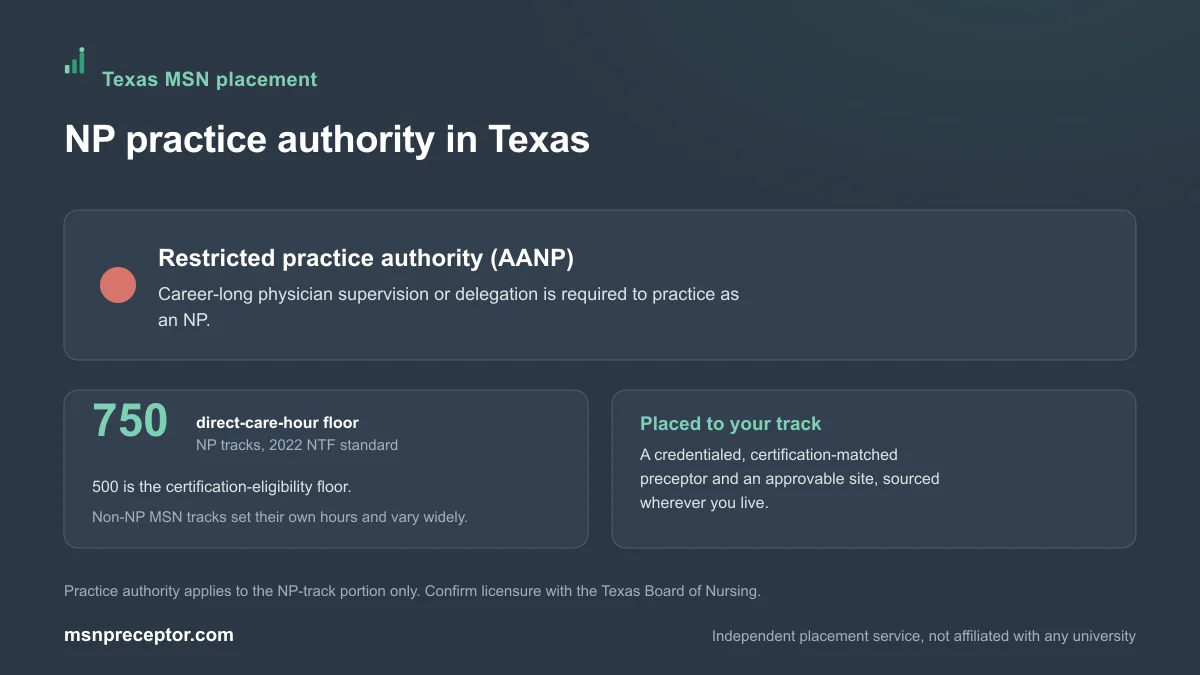
MSN practice requirements cannot be reduced to one reliable number. Hours vary with the program, pathway, course, and catalog year, and some courses may use field experiences that differ in purpose. Ask Texas State University to confirm the student's current requirement in writing, then use that answer rather than an online comparison or a figure from another pathway.
Use the MSN practicum hours overview for a general framework, not for a school-specific figure. A useful sourcing brief records the confirmed hours for this course, their learning purpose, the acceptable setting, how supervision is documented, and whether separate experiences need separate approvals.
The accreditation directory locates Texas State University in Round Rock, Texas, but a campus address does not establish where a student may complete an experience. Confirm state authorization and approved geography first. A proposed local or out-of-state site must still fit the course, support the required work, provide an eligible supervisor, and participate in the program's review.
For broader setting context, review the MSN practicum guide for Texas. It can help identify categories of clinical, education, leadership, informatics, public health, and systems sites, while the student's current program remains the authority on what is allowed.
Treat candidate sourcing and school approval as separate stages. We can organize role, credentials, site information, dates, objectives, availability, and requested documents for review. Texas State University alone decides whether the person and organization meet current course rules and whether any contracts, compliance steps, or additional forms are complete.
A complete search brief names the student's actual pathway and course and records the approved experience type, hours, dates, location, setting, person, credentials, objectives, forms, conflicts, affiliation steps, compliance items, and submission sequence. Confirm any blank with the field placement office rather than filling it with another school's practice.
The MSN placement workflow separates requirement review, candidate sourcing, documentation, and school approval. That sequence helps avoid asking the wrong professional or site to participate. After the current pathway and course rules are confirmed, request a match to start an independent search.
MSNPreceptor works independently of Texas State University and does not speak for its nursing program. Candidate sourcing is not school approval. We cannot guarantee availability, placement, affiliation completion, acceptance, course progression, or any other result, and the institution applies its own current rules.
It applies when the student's current MSN pathway or course requires a preceptor, mentor, or practicum site and the student has the current requirements needed for sourcing. Texas State University makes every approval decision.
No. The accreditation evidence establishes an accredited master's nursing degree on the verification date. It does not prove an NP concentration, education, leadership, informatics, public health, or another pathway, and it does not establish modality or placement policy.
There is no universal MSN practicum total. Required hours vary by program, pathway, course, and catalog year. Confirm the current handbook, degree audit, course instructions, and field placement office rather than relying on a generic number.
The answer follows the confirmed pathway and course. Direct-care NP, education, leadership, informatics, public health, quality, and other experiences can require different professionals and settings. The current program must approve the proposed role, credentials, site, and paperwork.
No. MSNPreceptor is an independent service that works separately from Texas State University. We source and document possible candidates for program review and do not guarantee placement or approval.
Last updated July 2026. Sources: Texas State University website; CCNE accredited program evidence; AACN The Essentials.
No cost to request. An advisor reviews the current course, pathway, location, and approval requirements before candidate sourcing begins.
We do not guarantee placement. Final approval rests with your program.
