An MSN practicum in Texas takes a different shape for every track, and we place students across all of them. Nurse practitioner students need a direct patient care preceptor licensed in Texas, while nurse educator, informatics, leadership, and clinical nurse leader students work under an experienced mentor in that role. Here is how those placements sit across a very large state, and how our desk secures them.
The Master of Science in Nursing is a single degree with many destinations. What your practicum looks like, where it happens, who supervises it, and how long it lasts all depend on your track. In Texas the largest group of MSN students is on a nurse practitioner path, but educator, informatics, leadership, and clinical nurse leader students are training for very different work.
The non prescriber tracks rely on a qualified mentor already doing the work, and they carry far fewer hours than the nurse practitioner tracks. See our MSN specialties guide for the differences.
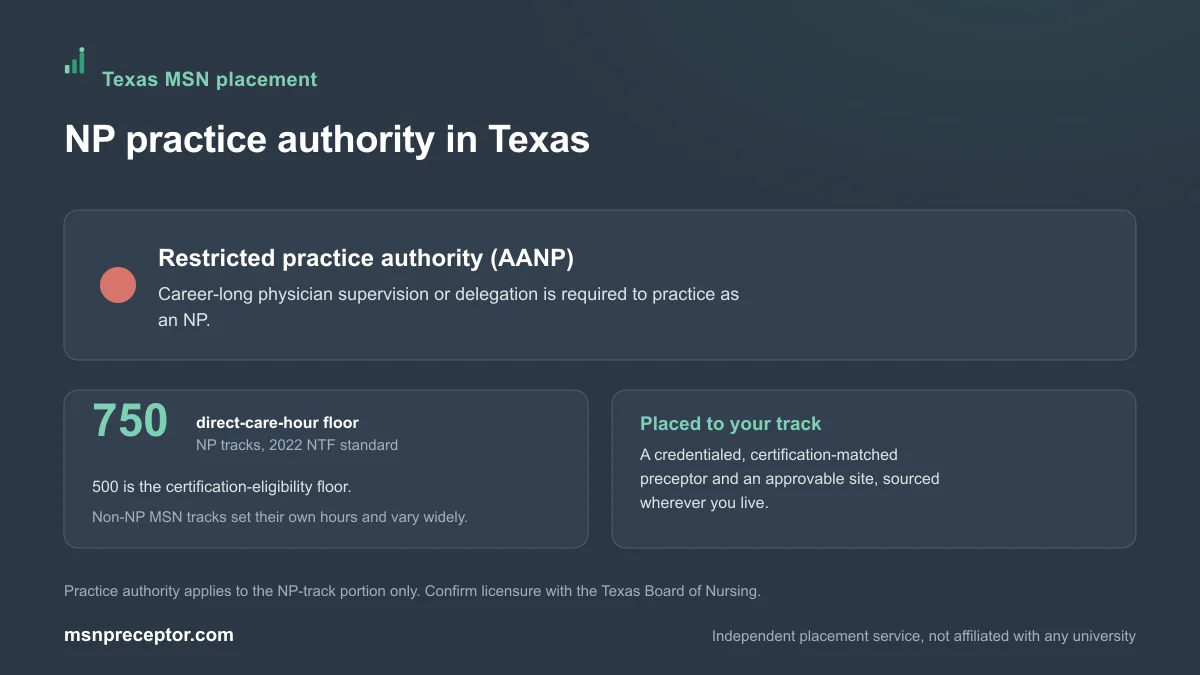
Texas is a restricted practice state under the AANP State Practice Environment. A nurse practitioner prescribes under a prescriptive authority agreement with a delegating physician, an arrangement that governs prescribing and includes periodic review of care. It defines how established nurse practitioners work in Texas, and it also shapes your clinical placement.
In practice, a nurse practitioner student is usually precepted by a nurse practitioner working under such an agreement, or by a physician, in either case licensed in Texas and board certified in a population that matches the student's track. For the educator, informatics, leadership, and clinical nurse leader tracks, the supervisor is set by the role rather than by prescriptive authority, so the restricted category has little effect. Verify the current requirements with the state board.
Because of the scale of Texas, almost every kind of placement exists somewhere in the state, but distance is a real factor in the search. The Houston area holds one of the largest medical complexes in the world, a deep base for nurse practitioner specialties as well as informatics and nurse executive practicum. Dallas and Fort Worth add large multi hospital systems and a growing health technology sector.
San Antonio brings major academic and military medicine, and Austin pairs an academic medical center with a strong health information technology and analytics scene, both useful for informatics and leadership tracks. The Rio Grande Valley, West Texas, and the Panhandle are more rural and medically underserved, where nurse practitioner direct care preceptors are in short supply. Educator practicum follows the many nursing schools statewide, and public health runs through the state health services department.
The upshot is that your metro shapes what is easy to find. A San Antonio informatics placement and a rural East Texas family practice preceptor are two very different searches.
There is no universal hour count for an MSN, so be careful with any single figure. Nurse practitioner tracks carry the heaviest load: the 2022 National Task Force standards recommend a minimum of 750 direct patient care hours per nurse practitioner track, national certification eligibility requires at least 500 faculty supervised hours, and accredited programs commonly publish somewhere from roughly 500 to 750 or more, with many still under 750. Simulation is not counted.
The educator, informatics, leadership, and clinical nurse leader tracks are far lighter, frequently in the range of roughly 100 to 200 program set practicum hours. Since the total belongs to your specific track and school, the only figure that matters for planning is the one in your own handbook. Our MSN clinical hours page explains how the totals are built, and hours by school lets you compare.
For any track, a placement is approved when the preceptor matches the track, holds the right Texas license or role, and agrees to sign your school's affiliation agreement at a site your program will accept. Nurse practitioner hours require a board certified nurse practitioner or a physician; the education, informatics, leadership, and clinical nurse leader tracks require an experienced professional already in that role.
Every program writes its own requirements, and we never promise that a school will approve a particular preceptor or site, because that decision is the school's. What we do is source candidates designed to clear the review. The steps are laid out on how it works.
We work the entire state, from the Houston, Dallas Fort Worth, San Antonio, and Austin metros to the rural valleys and plains, and we give you a straight read on what is realistic when a specialty is scarce nearby. We match preceptors and mentors to your exact track, then help push the affiliation paperwork through your school's clinical office.
When you are ready, request a match at our intake form or reach the desk through contact. There is no cost to ask, and nothing is billed until a match is confirmed and your program signs off. Placement is never guaranteed, and final approval rests with your school.
It shapes the supervision more than your paperwork. A nurse practitioner preceptor works under a prescriptive authority agreement with a physician and must be licensed in Texas and matched to your track. The educator, informatics, and leadership tracks are set by role and are largely unaffected.
It depends on your track. The Houston, Dallas Fort Worth, San Antonio, and Austin metros offer the deepest options for most specialties plus informatics and leadership, while rural regions can be thin for nurse practitioner direct care. See our specialties guide.
It is set by your track and program, not by the state. Nurse practitioner tracks run into the hundreds of direct care hours; educator, informatics, and leadership tracks are much shorter. Confirm the total in your handbook and see MSN clinical hours.
No. We are an independent service, open to students at any university. We source approvable preceptors and help move the paperwork, but approving any preceptor or site is always your program's decision.
Nothing to request a match, and nothing is billed until a match is confirmed and your school signs off. See our cost page for details.
Last updated July 2026. Sources: AANP: State Practice Environment; Texas Board of Nursing; AANP: Texas.
No cost to request. An advisor reviews the current course, pathway, location, and approval requirements before candidate sourcing begins.
We do not guarantee placement. Final approval rests with your program.
