When the student's current MSN pathway or course requires a preceptor, mentor, or practicum site, our role is to source and document a possible match for Columbia University review. The institution remains the approval authority, and the accreditation evidence on this page establishes only an accredited master's nursing degree.
The compact record deliberately separates an accreditation fact from placement assumptions. Columbia University is included because of its master's nursing accreditation evidence. The record does not establish what concentrations it offers, whether a course has field hours, or whether the student, school, or another party sources a site.
The accreditation fact for Columbia University comes from CCNE and was verified for this roster on July 21, 2026. Its scope is degree accreditation. The source does not prove a particular specialty, course format, practicum requirement, student sourcing model, review timeline, or candidate qualification standard.
Start with the documents controlling the student's actual term. The course number, pathway, objectives, dates, approved geography, setting type, candidate credentials, affiliation requirements, compliance items, and submission forms should all be confirmed before anyone contacts a potential site. Older catalogs or another university's rules are not reliable substitutes.
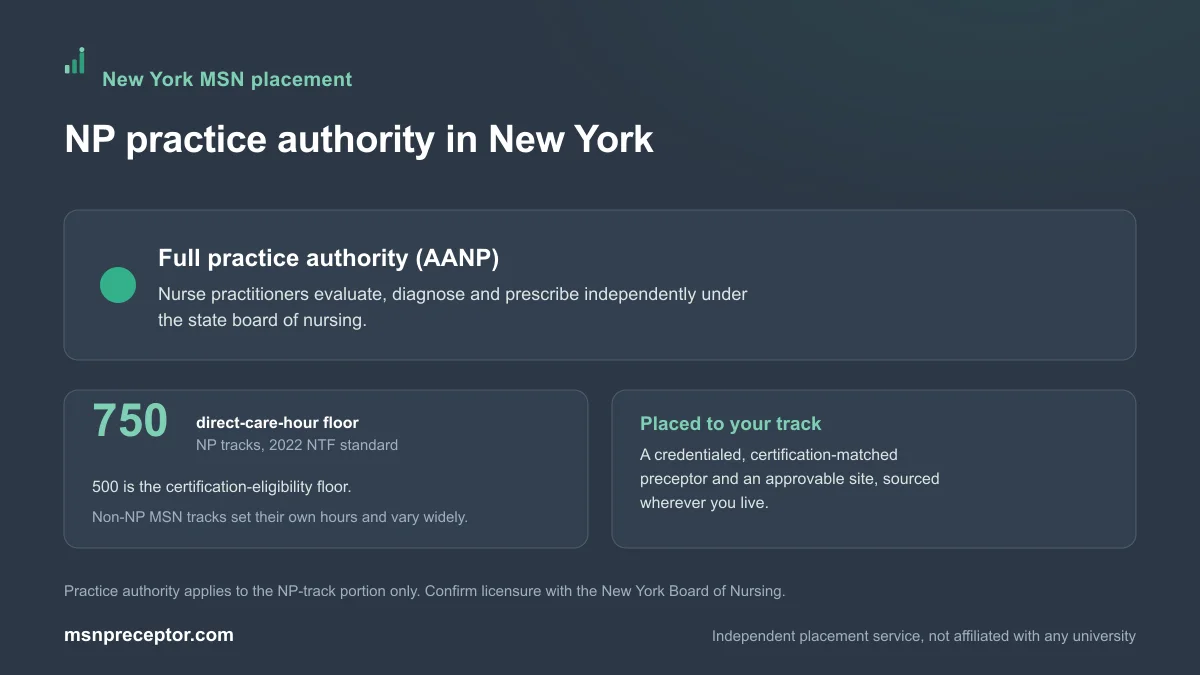
A direct-care NP course can require a clinical site and a nurse practitioner or physician whose certification and patient population align with the student's focus. Programs may examine licensure, board status, practice activity, supervision, patient access, conflicts, and site paperwork. Nothing in the accreditation record shows that Columbia University offers an NP concentration, so the student must first confirm the pathway and its current rules.
Non-NP field experiences can place the learning objective outside direct patient care. Education may involve teaching or professional development; leadership may involve systems, operations, administration, or quality. The proposed mentor needs experience that matches the confirmed course. Do not infer that Columbia University offers either option from its master's accreditation.
Systems-oriented pathways add another set of possibilities. Informatics might involve data, implementation, workflow, or clinical technology, while public health, care coordination, quality, community health, or clinical nurse leader work may need different organizations and mentors. Review the MSN pathway distinctions, then confirm the exact offering and eligibility rules with the program.
Do not estimate a student's requirement from the MSN label. There is no universal practicum total, and required hours vary across programs, pathways, courses, and catalog years. Use Columbia University's current documents and field placement guidance to confirm both the total and the purpose of the experience. The MSN hours guide explains why totals differ.
A broad explanation is available in the MSN clinical hours guide, but the student's course documents are controlling. Confirm whether the experience is direct care, education, leadership, systems, community, quality, or another purpose so the candidate and site are screened against the right objectives.
Use New York, New York as directory context only. A student's actual search area should come from current Columbia University guidance about authorized states, course location, site eligibility, and affiliation. Even inside an approved area, a willing professional or organization is not automatically an eligible match.
The statewide MSN guide for New York can support a local search plan. Apply the exact pathway, course, geography, role, and site criteria confirmed by the program before treating any setting as a viable proposal.
A complete proposal connects the current course to a specific person and setting. Document the candidate's credentials, role, experience, site, availability, supervision plan, and willingness to complete school paperwork. This preparation helps Columbia University review the request but cannot replace its affiliation, compliance, authorization, background, or approval process.
Before a candidate is contacted, verify the pathway, course, practicum purpose, hours, term dates, location authorization, eligible setting, supervisor role, required license or certification, experience standard, affiliation process, compliance checklist, forms, conflicts, and school deadline. A missing requirement can change who or what counts as a useful match.
The MSN placement workflow separates requirement review, candidate sourcing, documentation, and school approval. That sequence helps avoid asking the wrong professional or site to participate. After the current pathway and course rules are confirmed, request a match to start an independent search.
MSNPreceptor is an independent service that works separately from Columbia University. We do not act for the institution, decide eligibility, or guarantee that a preceptor, mentor, or site will be found or approved. The program and proposed site retain their own review authority, and no outcome is promised.
It applies when the student's current MSN pathway or course requires a preceptor, mentor, or practicum site and the student has the current requirements needed for sourcing. Columbia University makes every approval decision.
No. The accreditation evidence establishes an accredited master's nursing degree on the verification date. It does not prove an NP concentration, education, leadership, informatics, public health, or another pathway, and it does not establish modality or placement policy.
There is no universal MSN practicum total. Required hours vary by program, pathway, course, and catalog year. Confirm the current handbook, degree audit, course instructions, and field placement office rather than relying on a generic number.
The answer follows the confirmed pathway and course. Direct-care NP, education, leadership, informatics, public health, quality, and other experiences can require different professionals and settings. The current program must approve the proposed role, credentials, site, and paperwork.
No. MSNPreceptor is an independent service that works separately from Columbia University. We source and document possible candidates for program review and do not guarantee placement or approval.
Last updated July 2026. Sources: Columbia University website; CCNE accredited program evidence; AACN The Essentials.
No cost to request. An advisor reviews the current course, pathway, location, and approval requirements before candidate sourcing begins.
We do not guarantee placement. Final approval rests with your program.
