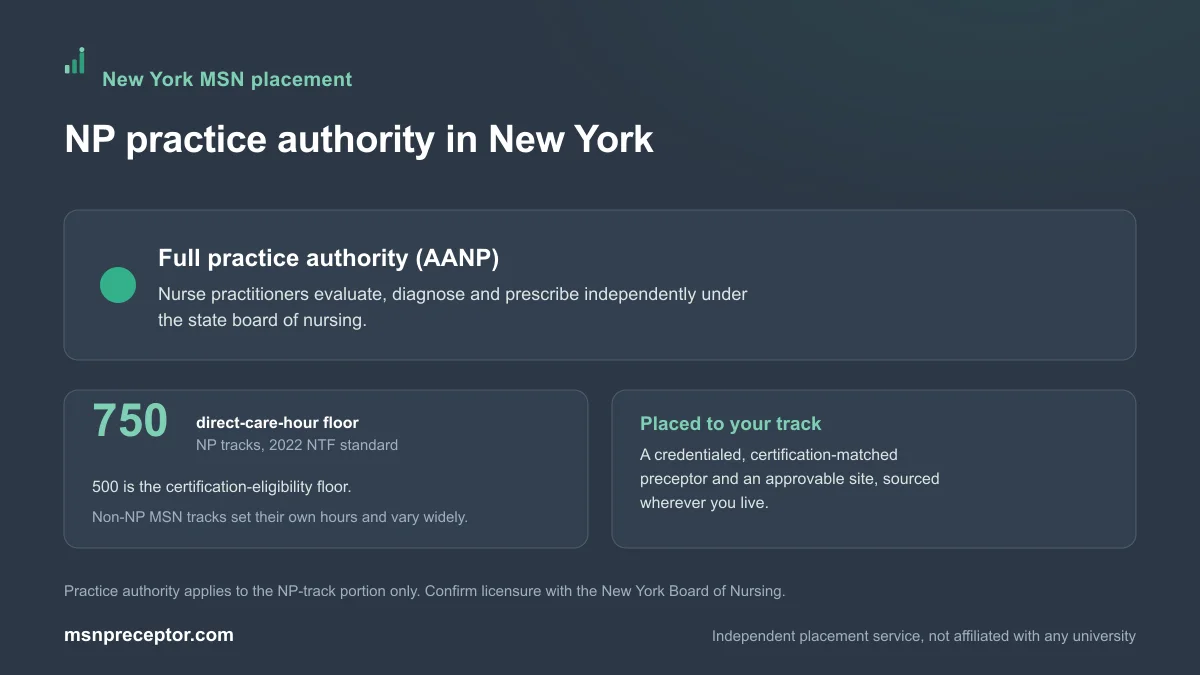
MSN students across New York can place in far more than one kind of site, and we match students at any university in any track. That runs from the nurse practitioner specialties, which need a direct-care preceptor, to the educator, informatics, and leadership tracks, which need an experienced mentor. New York is a full practice authority state for experienced NPs, a detail that shapes the supervision behind your placement.
An MSN is a master's degree with many branches, and we match students at any New York university in any of them. The nurse practitioner tracks, family, psychiatric mental health, adult-gerontology primary and acute care, pediatric, women's health, and neonatal, each need supervised direct-patient-care hours with a preceptor licensed in New York. The non-NP tracks, educator, informatics, leadership and administration, clinical nurse leader, and public health, need an experienced mentor in that role.
Handling the full degree rather than one specialty lets us scope your placement to your specific course and term. If you are still choosing a focus, our MSN specialties guide walks through how the tracks differ.
New York gives experienced nurse practitioners full practice authority, but with a threshold. An NP who has completed at least 3,600 qualifying practice hours can work without a written collaborating-physician agreement, while an NP below that threshold practices under a written agreement with a physician in the relevant specialty. In 2026 the state extended this arrangement through July 1, 2030, so it is current but still set by a sunset date rather than made permanent.
For your practicum, the takeaway is simple. You still need a qualified, New York-licensed preceptor matched to your track, whether that preceptor practices independently or under an agreement. We verify licensure and specialty before a placement is confirmed, and you should confirm any current rule with the New York State Education Department, Office of the Professions, which regulates nursing in the state.
The tracks that no single-specialty service places are a core focus here. Each needs a specific site and an experienced mentor rather than a prescriber:
New York's density of systems and agencies makes these placements more findable here than in most states, though the best sites fill early.
New York packs an unusually deep set of practicum settings, and they spread well beyond the city. The New York City metro and Long Island hold the largest concentration of academic medical centers, health-system IT and analytics teams, and public health agencies, which makes the city the strongest ground for informatics and leadership practicum.
Upstate adds its own bases. The Capital Region around Albany, Western New York around Buffalo, the Finger Lakes around Rochester, and Central New York around Syracuse each carry teaching hospitals, universities, and health systems. The Hudson Valley, Southern Tier, Mohawk Valley, and North Country stretch into more rural care where NP direct-care preceptors matter most and are more spread out. Nurse educator placements follow the state's many schools of nursing and community colleges.
How many hours you owe comes down to your track, not New York. For the NP tracks, the 2022 national standards recommend a minimum of 750 direct-care hours, certification eligibility requires at least 500 faculty-supervised hours, and accredited programs commonly publish totals from roughly 500 to 750 or more, with some below 750. Simulation is not counted as direct-care time.
The educator, informatics, leadership, and clinical nurse leader tracks carry much lighter loads, often in the range of roughly 100 to 200 hours set by the program. Confirm the exact figure with your school, and compare ranges in NP hours by school and MSN clinical hours.
The match has to fit the track. NP direct-care hours require a board-certified nurse practitioner or a physician; a nurse educator practicum needs an experienced educator; informatics needs a working informaticist; a leadership practicum needs a nurse executive. Your program sets the specifics, and we screen candidates against them first.
Want a hand? Send your university, track, and the part of New York you are in, and we will scope options and handle outreach. Begin at how it works, see cost, or go straight to match.
An NP with at least 3,600 qualifying hours can practice without a written physician agreement, a provision the state extended through July 1, 2030; NPs below that threshold work under a collaborative agreement. As a student you still need a New York-licensed preceptor matched to your track. Confirm current rules with the state's Office of the Professions.
No. We place every MSN track for students at any university, including the educator, informatics, leadership, and clinical nurse leader tracks that specialty sites do not cover. See MSN specialties.
The New York City metro and Long Island hold the deepest set of health-system IT, analytics, and executive settings, so those placements are most findable there, though upstate metros like Buffalo, Rochester, Syracuse, and Albany also carry them.
It depends on your track. NP tracks run into the many hundreds of direct-care hours, while educator, informatics, and leadership tracks carry far fewer. Confirm your own total, and see MSN clinical hours.
Send your university, track, and location and we will scope New York options and outreach. See how it works, review cost, or go to match.
No cost to request. An advisor reviews the current course, pathway, location, and approval requirements before candidate sourcing begins.
We do not guarantee placement. Final approval rests with your program.
