An MSN practicum in West Virginia depends on your track, and our desk covers every one of them. Nurse practitioner students need a direct-care preceptor licensed in West Virginia for hundreds of clinical hours, while educator, informatics, leadership, and clinical nurse leader students need a qualified mentor in the role for far fewer. Wherever you live in the state, we find the match and help move your school's approval.
Your MSN is a single degree with many tracks, and the practicum is sized to the track, not the degree. Start by confirming the required total in your own program's handbook.
See MSN clinical hours for the breakdown, and always confirm your own number.
The NP tracks are the largest share of MSN students, and every one needs a preceptor who is board certified in the matching population focus, licensed in West Virginia, and providing direct patient care. We look across all of them rather than one specialty:
Psychiatric-mental health and some acute-care preceptors are the hardest to find in a rural state, which is exactly why an early, statewide search pays off. Compare program totals on hours by school.
Not every MSN ends in a prescriber role. These tracks rely on a qualified mentor in the position rather than a physician, and they carry a smaller practicum:
In West Virginia these roles concentrate in the larger systems, so location matters more than it does for direct-care hours. Tell us your track and we will match the mentor.
West Virginia is small and mostly rural, and its clinical settings cluster in a handful of places.
Educator practicum follows the nursing programs in the larger towns, while direct-care preceptors are spread thin and reward an early search.
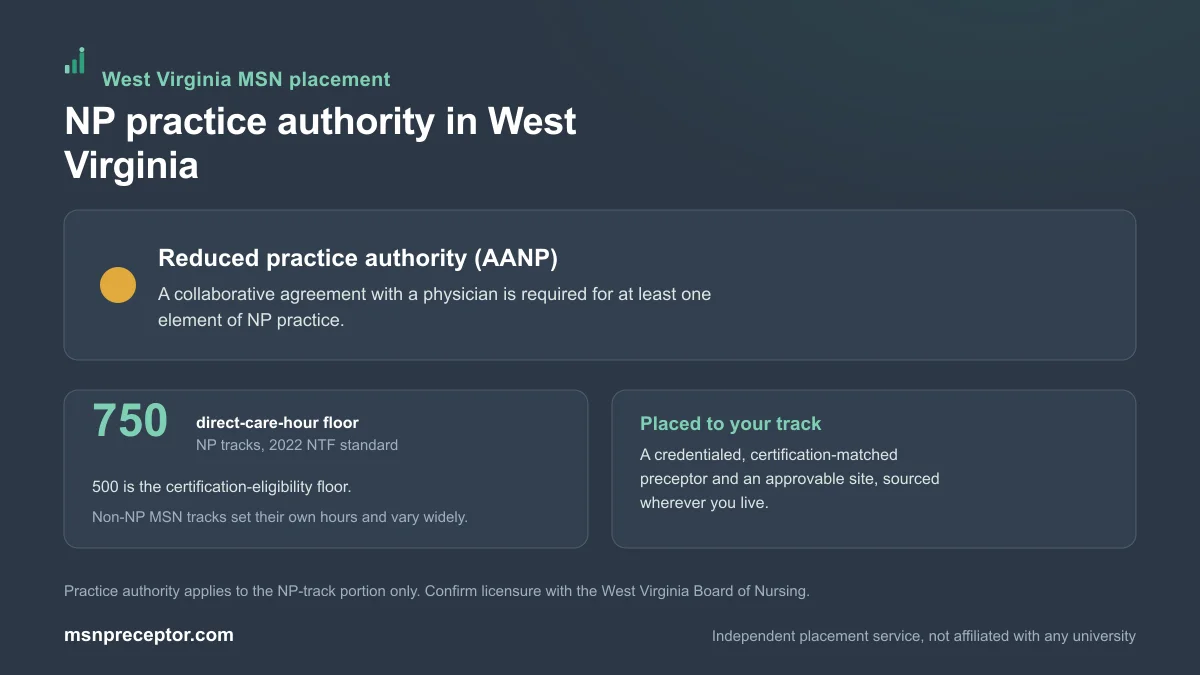
West Virginia is a reduced-practice state under the AANP State Practice Environment, which mainly affects the NP tracks. It shapes the supervision arrangement, so it is worth knowing before the search.
We factor this in when choosing a preceptor, and we recommend confirming the current rule with the West Virginia RN Board.
We are an independent placement desk, separate from any university, and we never promise a placement or an approval. We take on the search and the coordination so a rural or specialty match does not stall your term.
Read how it works, then contact the desk or request a match. You are billed only after a match is confirmed and approved.
No. We place every MSN track, including nurse educator, informatics, leadership, and clinical nurse leader students, matched to a mentor in the role, alongside the NP tracks. See MSN specialties.
It is set by your track, not the state. NP tracks require hundreds of direct patient-care hours, commonly about 500 to 750 or more, while non-NP tracks carry far fewer, often around 100 to 200. Confirm your own total with your program.
It mainly affects the NP tracks, where a nurse practitioner prescribes under a written collaborative agreement with a physician until qualifying to prescribe without one. Your preceptor must be licensed and practicing in West Virginia and matched to your focus. Non-NP tracks follow a mentor in the role.
We try, and we are candid about supply. Outside Morgantown, Charleston, and Huntington, direct-care and specialty preceptors thin out, so rural searches need more lead time. Starting a term ahead makes a match far more realistic.
Last updated July 2026. Sources: West Virginia RN Board: Advanced practice resources; West Virginia Code 30-7-15b: Prescriptive authority; AANP: State Practice Environment.
No cost to request. An advisor reviews the current course, pathway, location, and approval requirements before candidate sourcing begins.
We do not guarantee placement. Final approval rests with your program.
