Your MSN practicum in Vermont depends on the track you are in, and we place students across the entire range. Nurse practitioner students need a direct patient care preceptor licensed in Vermont, while nurse educator, informatics, leadership, and clinical nurse leader students train under an experienced mentor in that role. Below is how those placements map across a small, rural state and how our desk secures them.
A Master of Science in Nursing is one degree covering many roles, and each track carries its own practicum with its own setting, supervisor, and length. In Vermont, as elsewhere, most MSN students are on a nurse practitioner track, but others are preparing to teach, to manage clinical information systems, or to lead, and those placements look nothing alike.
The tracks beyond direct care rely on a qualified mentor in the role rather than a prescriber, and they run far shorter. Our MSN specialties guide breaks each one down.
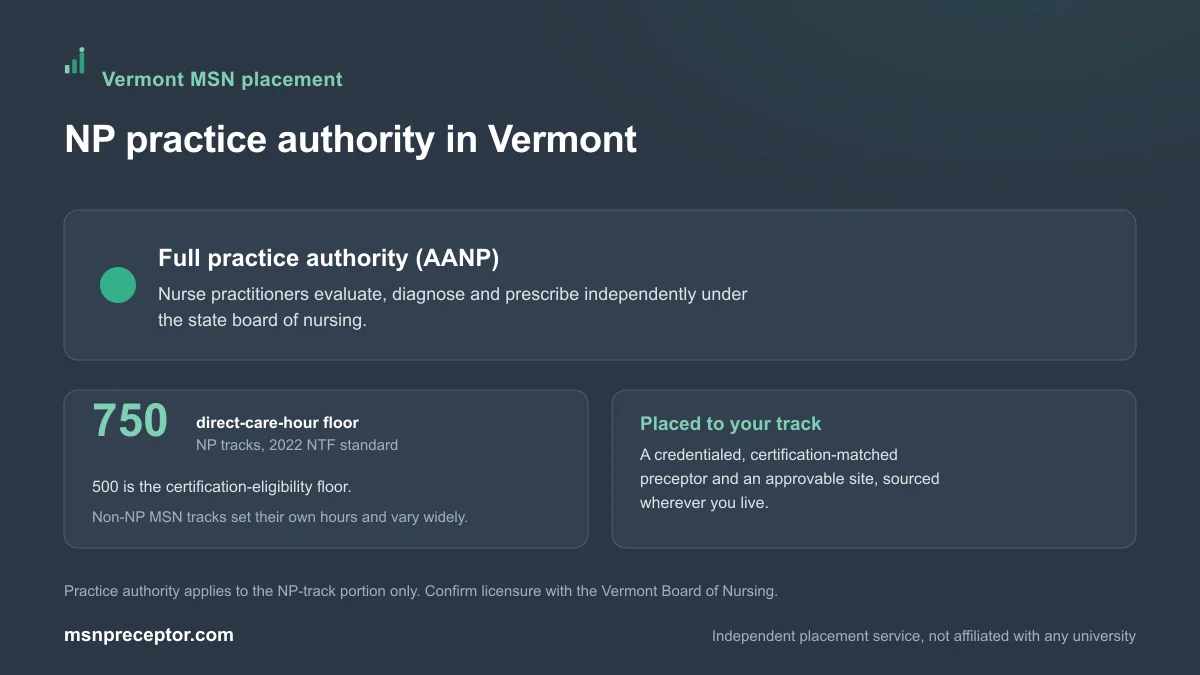
Vermont is a full practice state under the AANP State Practice Environment. An experienced nurse practitioner practices independently under the state board's authority. A nurse practitioner with fewer than 24 months and 2,400 hours in the role first works under a formal agreement with a collaborating provider who carries several years of experience.
For a student, this shapes who can precept you rather than adding steps to your own file. Your nurse practitioner preceptor must be licensed and practicing in Vermont and board certified in a population that matches your track, and a physician can also serve. For the educator, informatics, leadership, and clinical nurse leader tracks, the mentor is defined by the role, so practice authority has little bearing. Confirm current details with the state board.
Vermont is small and largely rural, and its clinical capacity gathers around a handful of hospitals. Burlington holds the state's academic medical center and its university, which makes it the primary base for nursing informatics, analytics, and nurse executive practicum as well as most specialty direct care. It is where the deepest options sit for nearly every track.
Rutland, the Berlin and Montpelier area in central Vermont, and Bennington in the southwest add regional hospitals, while a network of federally qualified health centers reaches smaller communities. Nurse practitioner direct care extends into the Northeast Kingdom and other rural counties, where preceptors can be genuinely scarce. Educator practicum follows the state's universities and colleges, and public health runs through the state health department.
For most tracks the search begins in and around Burlington, but a nurse practitioner student in a rural county often needs a wider net, which is the search we take on.
There is no single hour count for an MSN, and you should not assume one. Nurse practitioner tracks are the demanding ones: the 2022 National Task Force standards recommend a minimum of 750 direct patient care hours for each nurse practitioner track, certification eligibility requires at least 500 faculty supervised hours, and accredited programs commonly publish anywhere from roughly 500 to 750 or more, with many still below 750. Simulated time is excluded.
The educator, informatics, leadership, and clinical nurse leader tracks are much lighter, often in the range of roughly 100 to 200 practicum hours set by each program. Because the requirement follows your specific track and school, the number that matters for your term is the one in your own handbook. See MSN clinical hours for how totals are built and hours by school to compare.
Whatever your track, a placement is approved when the preceptor fits the track, holds the right Vermont license or role, and will sign your program's affiliation agreement at a site your school accepts. Nurse practitioner hours call for a board certified nurse practitioner or a physician; the education, informatics, leadership, and clinical nurse leader tracks call for an experienced professional already working in that capacity.
Each program sets its own requirements, and we never promise that a school will approve a specific preceptor or site, because that decision is the school's alone. What we do is put forward candidates built to clear the review. The full process is on how it works.
We search all of Vermont, from the Burlington area to the Northeast Kingdom, and we are candid about timelines when a specialty is thin. We match preceptors and mentors to your exact track and help move the affiliation paperwork through your school's clinical office.
To begin, request a match through our intake form or reach us at contact. There is no cost to ask, and nothing is billed until a match is confirmed and your program signs off. Placement is never guaranteed, and final approval always rests with your school.
It affects how an established nurse practitioner works, not what your school needs from a preceptor. You still need someone licensed and practicing in Vermont, matched to your track, and willing to sign your affiliation paperwork. In rural counties the real limit is supply.
Yes. Nurse educator, informatics, leadership, and clinical nurse leader students place under an experienced mentor in the role rather than a prescriber. Most of those settings cluster around Burlington and the state's universities. See our specialties guide.
It depends on your track and program, not on Vermont. Nurse practitioner tracks run into the hundreds of direct care hours; educator, informatics, and leadership tracks are far shorter. Confirm the total in your handbook and see MSN clinical hours.
No. We are independent of every university. We source approvable preceptors and help with the paperwork, but approving any preceptor or site is always your program's decision.
No. Requesting a match is free, and nothing is billed until a match is confirmed and your school signs off. Our cost page explains the model.
Last updated July 2026. Sources: AANP: State Practice Environment; Vermont Board of Nursing, Office of Professional Regulation; Vermont Board of Nursing: Nursing FAQs.
No cost to request. An advisor reviews the current course, pathway, location, and approval requirements before candidate sourcing begins.
We do not guarantee placement. Final approval rests with your program.
