Your MSN practicum in Tennessee depends on the track you are in, and we place students across the whole range. Nurse practitioner students need a direct patient care preceptor licensed in Tennessee, while nurse educator, informatics, leadership, and clinical nurse leader students train under an experienced mentor in that role. Below is how those placements map across the state and how we secure them.
A Master of Science in Nursing is not one path. It is a family of tracks, and the practicum each one requires is different in setting, in supervisor, and in length. Most Tennessee MSN students head toward a nurse practitioner role, but plenty are preparing to teach, to manage clinical information systems, or to lead, and those experiences share almost nothing operationally.
The tracks outside direct care lean on a qualified mentor in the role rather than a prescriber, and they run far shorter. Our MSN specialties guide lays out each one.
Tennessee gives MSN students an unusually deep bench for some tracks. Nashville is one of the country's true health business capitals, headquarters to a cluster of hospital companies and a dense health information technology and analytics sector, which makes it a standout market for nursing informatics and nurse executive leadership practicum. Its academic medical center and children's hospital round out direct care options across nearly every specialty.
Memphis adds major academic, children's, and safety net hospitals in the southwest, while Knoxville and Chattanooga anchor East Tennessee and the Tri Cities region covers the northeast corner. Educator practicum follows the state's many nursing schools. Nurse practitioner direct care sites reach statewide, though rural West Tennessee and the Appalachian counties in the east can be thin for specialty preceptors. Public and community health placements run through the state health department.
So the shape of your search depends on your track. Informatics and leadership students often look to the metros, educator students to the university towns, and nurse practitioner students to wherever a matching, licensed preceptor practices.
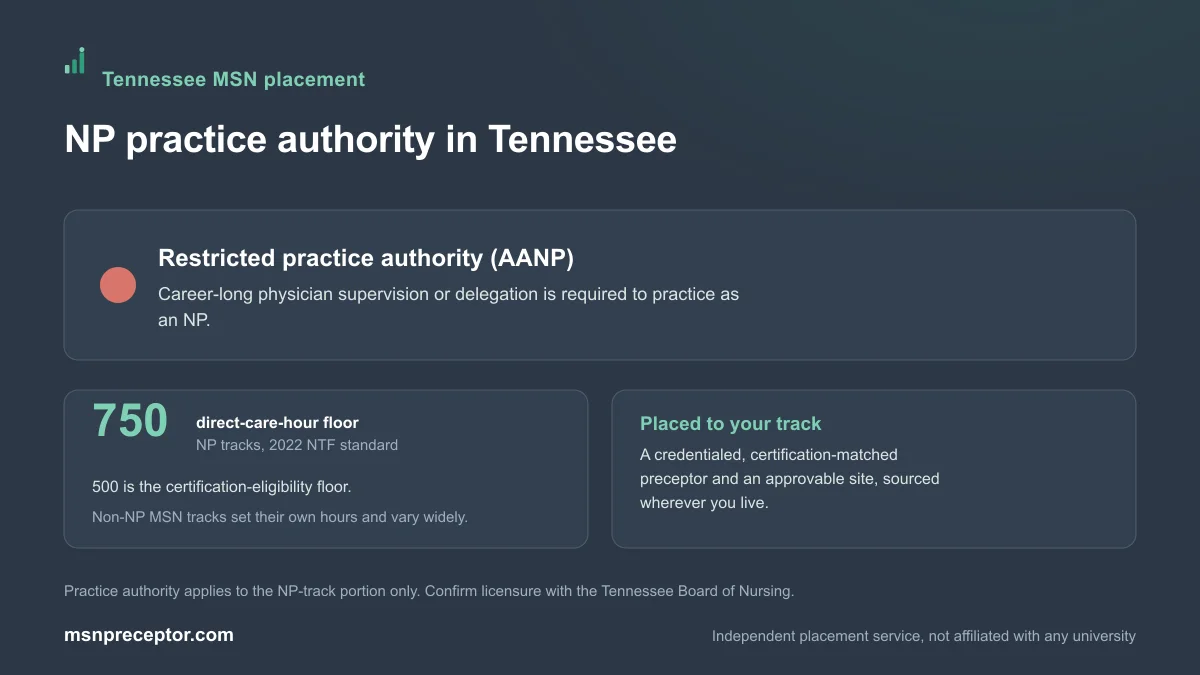
Tennessee is a restricted practice state under the AANP State Practice Environment. A nurse practitioner practices under a written collaborative arrangement with a supervising physician who periodically reviews care and anchors prescriptive authority. This is a feature of how established nurse practitioners work, and it also shapes your clinical placement.
For a nurse practitioner student, it usually means your preceptor is a nurse practitioner practicing inside that collaborative structure, or a physician, either way licensed in Tennessee and board certified in a population that matches your track. For the educator, informatics, leadership, and clinical nurse leader tracks, the supervisor is defined by the role rather than by prescriptive authority, so the restricted category has little bearing. Confirm the current rules with the state board.
No single number covers an MSN, and you should be wary of anyone who quotes one. Nurse practitioner tracks are the demanding ones: the 2022 National Task Force standards recommend at least 750 direct patient care hours for each nurse practitioner track, certification eligibility calls for a minimum of 500 faculty supervised hours, and accredited programs commonly land anywhere from roughly 500 to 750 or more, with many still below 750. Simulated hours are excluded.
The educator, informatics, leadership, and clinical nurse leader tracks are much lighter, often in the range of roughly 100 to 200 practicum hours defined by the program. Because the requirement follows your specific track and school, the number that governs your term is the one in your handbook. See MSN clinical hours for how totals are assembled and hours by school to compare.
Across every track, a placement clears review when the preceptor fits the track, carries the correct Tennessee license or role, and will sign your program's affiliation agreement at a site your school accepts. Nurse practitioner hours call for a board certified nurse practitioner or a physician; the education, informatics, leadership, and clinical nurse leader tracks call for an experienced professional already working in that capacity.
Each program sets its own rules, and we never promise that a school will approve a specific preceptor or site, since that call belongs to your program. Our job is to put forward candidates built to pass that review. The full process is on how it works.
We search all of Tennessee, from the Nashville and Memphis metros to the rural counties, and we are honest about timelines when a specialty runs thin. We match preceptors and mentors to your exact track and help move the affiliation paperwork through your school's clinical office.
To begin, request a match through our intake form or reach us at contact. Asking costs nothing, and nothing is billed until a match is confirmed and your program approves it. We do not guarantee placement, and final approval always rests with your school.
It shapes the supervision arrangement more than the paperwork you file. Your nurse practitioner preceptor typically works under a collaborative arrangement with a physician, and must be licensed in Tennessee and matched to your track. The non nurse practitioner tracks are set by role and are largely unaffected.
Nashville's health technology and hospital sector make the state strong for informatics and leadership practicum, and its universities support educator placements. Nurse practitioner direct care is available statewide but thinner for some specialties in rural areas. See specialties.
That depends on your track and school, not on Tennessee. Nurse practitioner tracks run into the hundreds of direct care hours; educator, informatics, and leadership tracks are far shorter. Confirm the figure in your handbook and see MSN clinical hours.
No. We are independent of every university. We source approvable preceptors and help with the paperwork, but approving any preceptor or site is always your program's decision.
No. Requesting a match is free, and nothing is billed until a match is confirmed and your school signs off. Our cost page explains the model.
Last updated July 2026. Sources: AANP: State Practice Environment; Tennessee Board of Nursing; AANP: Practice Information by State.
No cost to request. An advisor reviews the current course, pathway, location, and approval requirements before candidate sourcing begins.
We do not guarantee placement. Final approval rests with your program.
