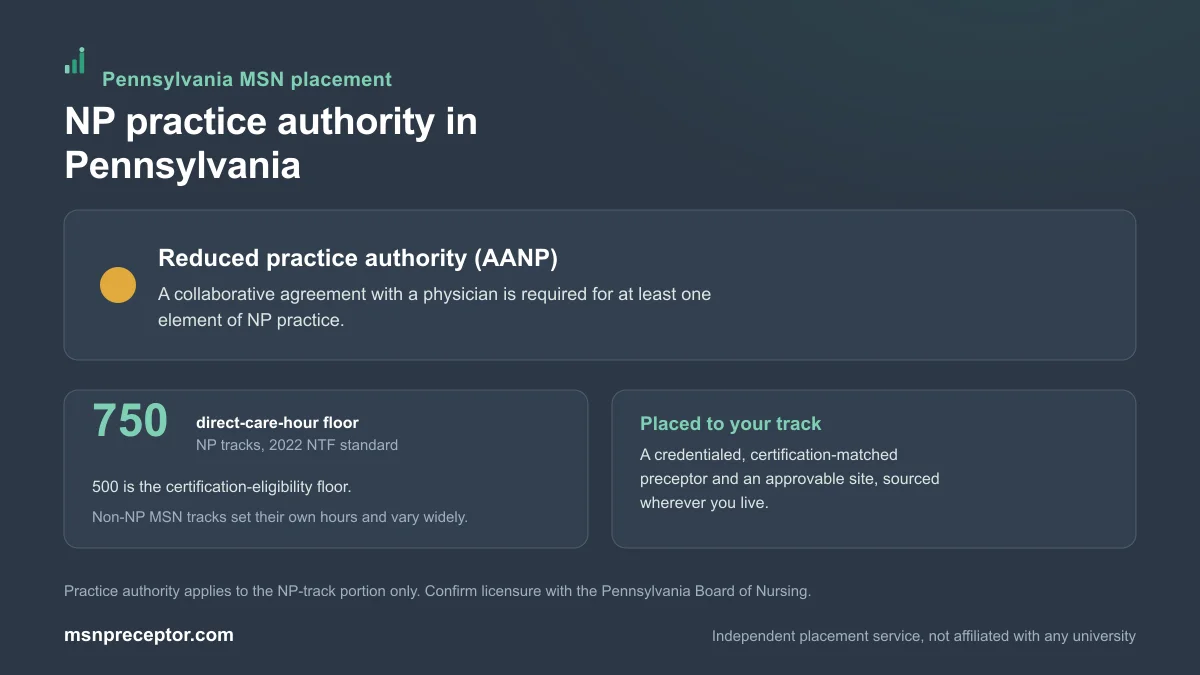
We place MSN students across Pennsylvania in every track, not just the nurse practitioner routes. For clinical tracks that means a direct-patient-care preceptor, and for nurse educator, informatics, leadership, and clinical nurse leader tracks it means a mentor who already holds that role. Pennsylvania is a reduced practice authority state, so NP practicum arrangements involve a physician collaborative agreement, which is worth planning around early.
An MSN is a family of degrees, and the practicum you need depends on which one you are earning. A Pennsylvania NP student needs supervised patient-care hours, while an educator, informatics, or leadership student needs a mentor working inside that function. We cover the whole span.
The non-NP tracks are the ones a single-specialty service usually cannot help with, and they are a large part of what we do here.
Most Pennsylvania MSN students are on an NP track. Each track, whatever the population focus, needs supervised direct-patient-care hours with a preceptor who holds the matching license, which means a board-certified nurse practitioner or a physician in the same area of care.
We treat the NP tracks as one category on this page and leave the deep, specialty-by-specialty work to our sister desks. What every NP student shares is the need for an appropriately licensed preceptor and a site their program will approve.
The educator, informatics, leadership, and clinical nurse leader tracks do not need a prescriber. They need an experienced mentor already doing that job, and they carry far fewer hours, commonly around 100 to 200 depending on the program.
An educator practicum sits in a school of nursing or a hospital education department, an informatics practicum sits with a clinical-systems or analytics team, a leadership practicum shadows a nurse executive, and a clinical nurse leader practicum works in care coordination and unit leadership. Public and community health placements fill out the list. The mentor's real role has to line up with your track, since that is what programs check first. Our specialties overview goes deeper.
Pennsylvania is a reduced practice authority state under the AANP State Practice Environment. Nurse practitioners are licensed and certified through the Pennsylvania State Board of Nursing, and state law requires a written collaborative agreement with one or more physicians for NP practice.
For your practicum this matters in a practical way: the NP preceptor supervising your direct-care hours practices within that collaborative structure, and your program will want the arrangement documented cleanly. It does not stop you from training with a qualified NP preceptor, but it is a reason to line up your site early rather than late. Licensure and agreement details should be confirmed directly with the board.
None of this touches the non-NP tracks, because an educator, informatics, or leadership mentor is not prescribing during your hours.
There is no single hour requirement for an MSN, so be careful with any source that implies one. NP tracks are the heaviest: the 2022 National Task Force standards recommend a minimum of 750 direct-care hours, national certification requires at least 500 supervised hours, and accredited programs commonly publish totals from roughly 500 to 750 or more, some below 750. Non-NP tracks are much lighter, often around 100 to 200 hours. Simulation is excluded from placement hours.
Confirm your own program's total before you plan a schedule. Our MSN clinical hours guide compares tracks, and NP hours by school shows how published NP totals differ.
Pennsylvania is a big, mixed state, and its practicum capacity is uneven. The Philadelphia region in the southeast and the Pittsburgh region in the southwest hold the largest health systems and the deepest informatics, analytics, and nurse-executive teams, so leadership and informatics placements are most realistic there. Central hubs around Hershey and Danville and the Lehigh Valley in the east add major medical centers, and Harrisburg, Lancaster, Reading, Erie, and the Scranton area extend clinical and educator capacity.
The rural central and northern tier is the thinnest, with fewer specialists and smaller health-system departments, so NP specialty and informatics matches there usually need a wider radius or a longer lead time. Educator practicum tracks the many nursing programs spread across the state, and public health placements run through county and state health offices.
Across all of it, a Pennsylvania license and a program-approved site are what anchor your hours, so we match to in-state, appropriately licensed preceptors and mentors.
Give us your track, your region, your program's required hours, and your start term, and we build a shortlist of Pennsylvania preceptors and mentors who fit, including the collaborative-agreement piece for NP tracks. We are independent, we serve students at any university, and we are honest about the limits: we assist, and we do not guarantee placement or your school's approval of any preceptor or site.
Start with the match form or reach us through contact, and read how it works if you want the process first.
All tracks. NP students need a direct-care preceptor, and we also match nurse educator, informatics, leadership, clinical nurse leader, and public health students with a role-matched mentor.
Pennsylvania requires NPs to hold a written collaborative agreement with a physician. Your NP preceptor practices within that structure, so it helps to document the arrangement and line up your site early. Non-NP tracks are unaffected.
It depends on the track. NP tracks follow standards recommending at least 750 direct-care hours with certification requiring at least 500, while non-NP tracks commonly run about 100 to 200. Confirm your program's own number, and see our hours guide.
The rural central and northern counties are the tightest for NP specialists and health-system data teams. The Philadelphia and Pittsburgh regions are the deepest markets, especially for informatics and leadership.
No. We source and match preceptors and mentors, and your program makes the final call on any site or preceptor.
Last updated July 2026. Sources: Pennsylvania State Board of Nursing; AANP State Practice Environment; AANP Pennsylvania.
No cost to request. An advisor reviews the current course, pathway, location, and approval requirements before candidate sourcing begins.
We do not guarantee placement. Final approval rests with your program.
