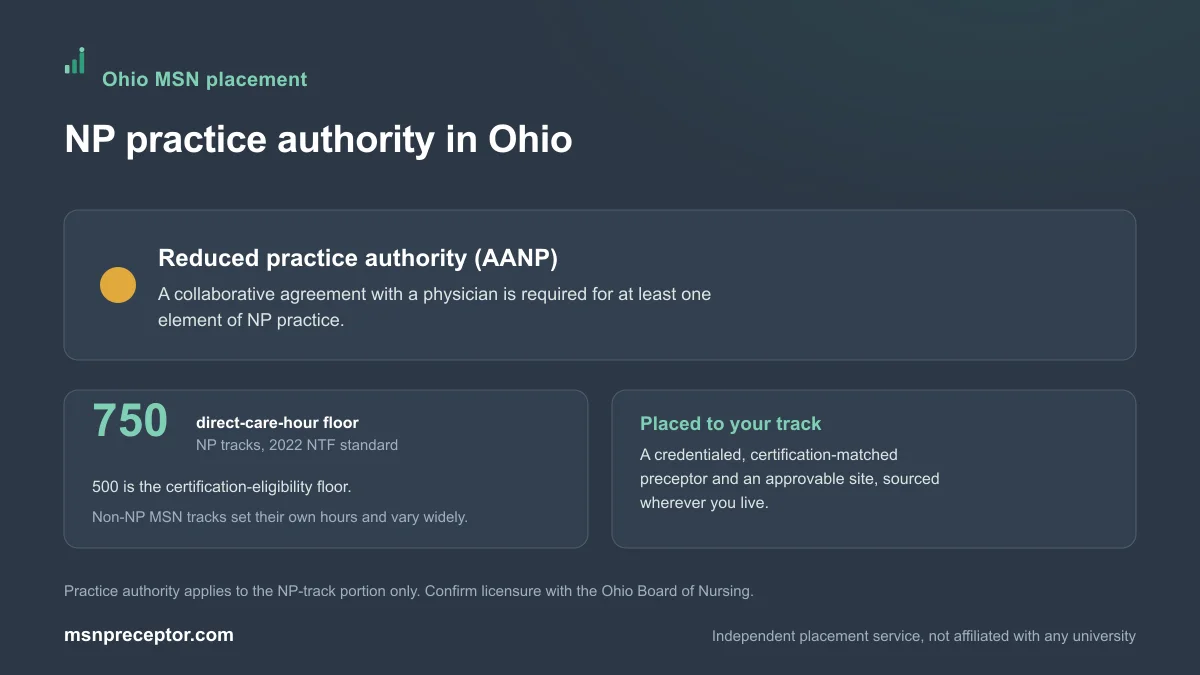
MSN students in Ohio can complete a practicum in many kinds of setting, and we match students at any university in any track. That runs from the nurse practitioner specialties, which each need a direct-care preceptor, to the educator, informatics, and leadership tracks, which need an experienced mentor. Ohio is a reduced practice state, which mainly shapes the supervision behind the NP tracks.
An MSN is the master's degree, and it carries many tracks that we place for students at any Ohio university. The nurse practitioner tracks, family, psychiatric mental health, adult-gerontology primary and acute care, pediatric, women's health, and neonatal, each need direct-patient-care hours with a preceptor licensed in Ohio. The non-NP tracks, nurse educator, nursing informatics, leadership and administration, clinical nurse leader, and public health, need an experienced mentor rather than a prescriber.
Working across the full degree lets us match your placement to your exact course. If you are weighing tracks, our MSN specialties guide lays out the differences.
The non-NP tracks are where general placement help falls short, and they are a focus for us. Each needs its own kind of site and mentor:
These tracks rest on a qualified mentor rather than a prescriber, so Ohio's collaboration rules have limited bearing on them.
Ohio is a reduced practice state. A certified nurse practitioner practices under a standard care arrangement, a written agreement with a collaborating physician, or in some roles a podiatrist, that sets out how the two work together. The board does not pre-approve the arrangement, but it can review it. Recent state legislation has begun to open an experience-based pathway and to allow the collaborator to be another advanced practice nurse in some cases, so the details are shifting.
For your practicum, this shapes the NP tracks more than the others. Your direct-care preceptor will usually work within that collaborative structure, and either a qualifying NP or a physician can serve if your program accepts it and the license matches your focus. The educator, informatics, and leadership tracks are not tied to prescriptive authority, so the arrangement matters less there. Confirm the current rule with the Ohio Board of Nursing.
None of this changes what you owe as a student. The collaboration rule sits between your preceptor and a physician, not between you and your preceptor, so your task is to secure a qualifying NP or physician who is licensed in Ohio, practices in your population focus, and is accepted by your school as a preceptor.
Ohio spreads its health systems across several large metros, which is good news for the non-NP tracks. Columbus, Cleveland, and Cincinnati each carry major academic medical centers and sizable health information technology and analytics operations, making them the strongest ground for informatics and leadership practicum. Dayton, Toledo, Akron, Canton, and Youngstown add further hospital bases.
Between and around those metros, and especially across the Appalachian southeast, care runs through community hospitals and clinics where NP direct-care preceptors are valuable and more spread out. Nurse educator placements track the state's many universities and community colleges, which sit in nearly every region.
The hours you need follow your track, not the state. NP tracks require direct-patient-care time: the 2022 national standards recommend a minimum of 750 hours, certification eligibility requires at least 500 faculty-supervised hours, and programs commonly publish totals in the range of roughly 500 to 750 or more, with some sitting below 750. Simulation does not count toward direct-care hours.
The non-NP tracks are much lighter, often around 100 to 200 hours as set by each program. Confirm your own required total, and compare figures in MSN clinical hours and NP hours by school.
Any match has to fit the track. NP direct-care hours need a board-certified NP or a physician working within Ohio's collaborative structure; the non-NP tracks need an experienced educator, informaticist, nurse executive, or clinical nurse leader. Your program sets the requirements, and we check candidates against them first.
If you want support, share your university, track, and city, and we will scope Ohio options and handle the outreach. Start at how it works, see cost, or go to match.
Yes. Your NP preceptor works under a standard care arrangement with a collaborating physician, and a qualifying NP or a physician can serve if your program accepts it and the license matches your focus. Recent legislation is shifting the details, so confirm current rules with the Ohio Board of Nursing.
No. We place every MSN track for students at any university, including the educator, informatics, leadership, and clinical nurse leader tracks that specialty sites do not cover. See MSN specialties.
Columbus, Cleveland, and Cincinnati hold the largest health-system IT, analytics, and executive settings, so those practicums are most findable there, with Dayton, Toledo, Akron, and Youngstown adding more.
It depends on your track. NP tracks require many hundreds of direct-care hours, while the non-NP tracks carry far fewer. Confirm your own program's total, and see MSN clinical hours.
Share your university, track, and city and we will scope Ohio options. See how it works, review cost, or go to match.
Last updated July 2026. Sources: AANP: State Practice Environment; Ohio Board of Nursing; Ohio Revised Code: Standard care arrangement (section 4723.431).
No cost to request. An advisor reviews the current course, pathway, location, and approval requirements before candidate sourcing begins.
We do not guarantee placement. Final approval rests with your program.
