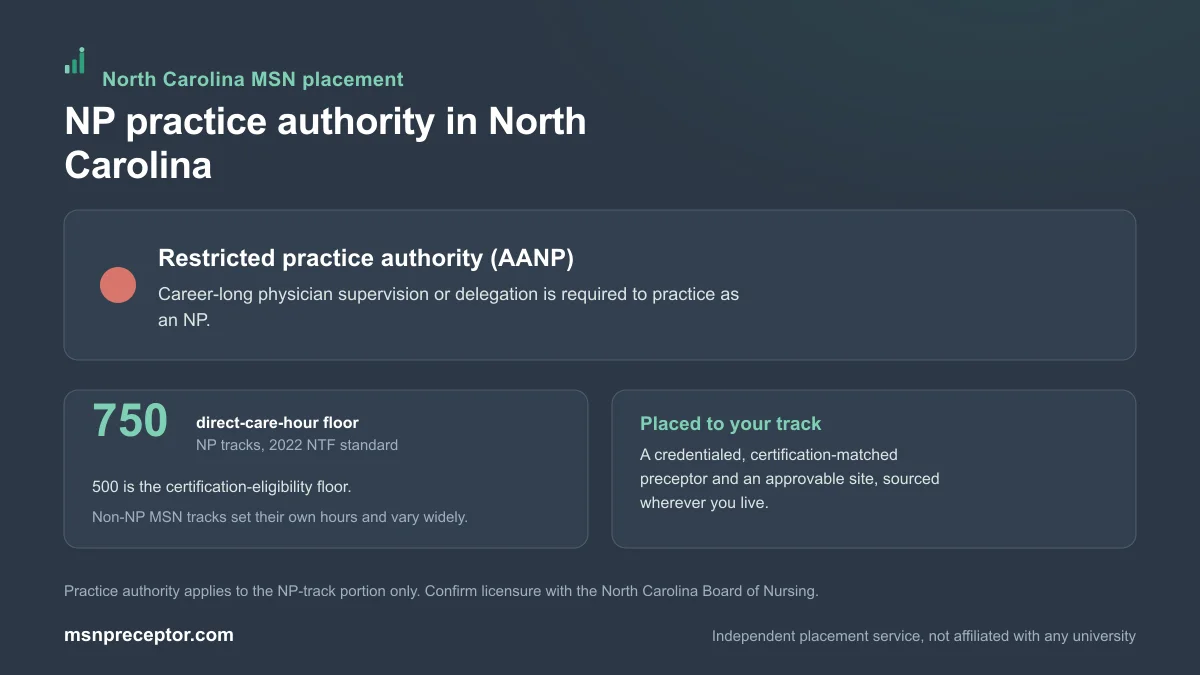
MSN students in North Carolina place across a wide set of sites, and we match students at any university in any track. That spans the nurse practitioner specialties, which each need a direct-care preceptor, and the educator, informatics, and leadership tracks, which need an experienced mentor. North Carolina is a restricted practice state, which mainly shapes the supervision behind the NP tracks.
MSN is the master's degree, and it splits into many tracks that we place for students at any university. The nurse practitioner tracks, family, psychiatric mental health, adult-gerontology primary and acute care, pediatric, women's health, and neonatal, each require direct-patient-care hours under a preceptor licensed in North Carolina. The non-NP tracks, nurse educator, nursing informatics, leadership and administration, clinical nurse leader, and public health, run on an experienced mentor rather than a prescriber.
Covering every track means we can match your practicum to the exact course you are taking. Our MSN specialties guide breaks down how the tracks differ in setting and hours.
North Carolina spreads its clinical and academic settings across several distinct regions. Charlotte anchors the largest metro. The Research Triangle of Raleigh, Durham, and Chapel Hill holds a dense cluster of teaching hospitals plus much of the state's health information technology and analytics work, which makes it the strongest base for informatics and leadership practicum.
The Piedmont Triad around Greensboro, Winston-Salem, and High Point adds another hospital base, while Asheville anchors the mountain west, Wilmington the coast, and Greenville the east. Beyond the metros, the rural east and the Appalachian west rely on community hospitals and clinics where NP direct-care preceptors are valuable and more scattered. The state's large community-college and university system gives nurse educator students plenty of potential teaching sites.
Because the deepest informatics, analytics, and executive settings sit in the Triangle and around Charlotte, students living elsewhere often place a non-NP practicum in a nearby city or partly at a distance, while keeping NP direct-care hours closer to home. Planning the two around your commute early tends to keep more options open.
North Carolina is a restricted practice state. A nurse practitioner works under a collaborative practice agreement with a supervising physician, and NP approval to practice is shared between the North Carolina Board of Nursing and the North Carolina Medical Board. Full practice authority has been proposed in the legislature more than once but is not law as of mid-2026.
For your practicum this mostly affects the NP tracks. Your direct-care preceptor will typically be a physician or an NP who practices under that supervisory structure, and either can serve as long as your program accepts the arrangement and the license matches your population focus. The non-NP tracks are not built on prescriptive authority, so this has little bearing on an educator, informatics, or leadership placement. Confirm current rules with the North Carolina Board of Nursing.
The non-NP tracks are the ones a clinic-only list will not solve, and they are central to this desk. Each calls for a matched site and mentor:
Because these tracks lean on a qualified mentor rather than a prescriber, the state's supervision rules matter far less to them.
Required hours track your specialty rather than the state. NP tracks lean on direct-patient-care time: the 2022 national standards recommend a minimum of 750 hours, certification eligibility requires at least 500 faculty-supervised hours, and programs commonly list totals in the range of roughly 500 to 750 or more, some of them lower. Simulation does not count toward that direct-care requirement.
The non-NP tracks are far lighter, commonly around 100 to 200 hours as each program defines. Always confirm your own total, and see MSN clinical hours for the breakdown.
A preceptor or mentor must match your track. NP hours need a board-certified NP or a physician working within the state's supervisory structure; the non-NP tracks need an experienced educator, informaticist, nurse executive, or clinical nurse leader. Your program defines the criteria, and we vet against them before you commit.
If you would like help, tell us your university, track, and city, and we will scope North Carolina options for you. Start with how it works, review cost, or jump to match.
Yes. In a restricted practice state your NP preceptor is a physician or an NP working under the required collaborative practice agreement; either can serve if your program accepts the arrangement and the license matches your focus. Confirm details with the North Carolina Board of Nursing.
No. We place every MSN track, and this desk also covers the educator, informatics, leadership, and clinical nurse leader tracks that specialty sites skip. Our MSN specialties guide goes track by track.
Barely. Educator, informatics, and leadership tracks rely on a qualified mentor rather than a prescriber, so North Carolina's NP supervision requirement has little bearing on them.
It depends on your track, not the state. NP tracks require many hundreds of direct-care hours; the non-NP tracks carry far fewer. Confirm your own program's total, and see MSN clinical hours.
Send your university, track, and city and we will scope North Carolina options. See how it works, review cost, or go to match.
Last updated July 2026. Sources: AANP: State Practice Environment; North Carolina Board of Nursing; North Carolina Board of Nursing: Nurse Practitioner.
No cost to request. An advisor reviews the current course, pathway, location, and approval requirements before candidate sourcing begins.
We do not guarantee placement. Final approval rests with your program.
