New Hampshire is small and unevenly settled, and an MSN practicum here follows that shape. Nurse practitioner students need a direct-patient-care preceptor licensed in the state, while educator, informatics, leadership, and clinical nurse leader students need a role-matched mentor for far fewer hours. We are independent, we work with MSN students at any university, and we source and coordinate the site your program will recognize.
The Master of Science in Nursing is one degree with tracks that place in very different rooms, so start with the track you are in rather than the school you attend. Our MSN specialties guide compares them.
Population and health care cluster in the southern tier around Manchester, Nashua, Salem, and the capital at Concord, with a second concentration on the Seacoast around Portsmouth and Dover and a large academic health system anchored in Lebanon in the Upper Valley. Those areas hold most of the direct-care volume for the NP tracks and most of the specialized roles for the non-NP tracks.
North of the notches the state turns rural. The North Country around Berlin, Littleton, and Colebrook runs on critical access hospitals and community health centers, where NP preceptors often have capacity and little student competition. A note for border-area students: many live minutes from Massachusetts, but a New Hampshire rotation needs a New Hampshire-licensed preceptor, so plan around your own program's state rules.
The non-NP tracks lean toward the larger systems. Informatics and executive-leadership mentors concentrate around the Upper Valley academic system and the Manchester and Concord hospitals, where analytics, clinical-systems, and nurse-executive roles exist, and because these tracks carry far fewer hours, one strong mentor usually covers the whole practicum.
Educator practicum is easier to spread out, since the state's community-college nursing programs and schools of nursing sit in Concord, Manchester, the Seacoast, and beyond. Public and community health practicum runs through the state health department and its regional public-health networks.
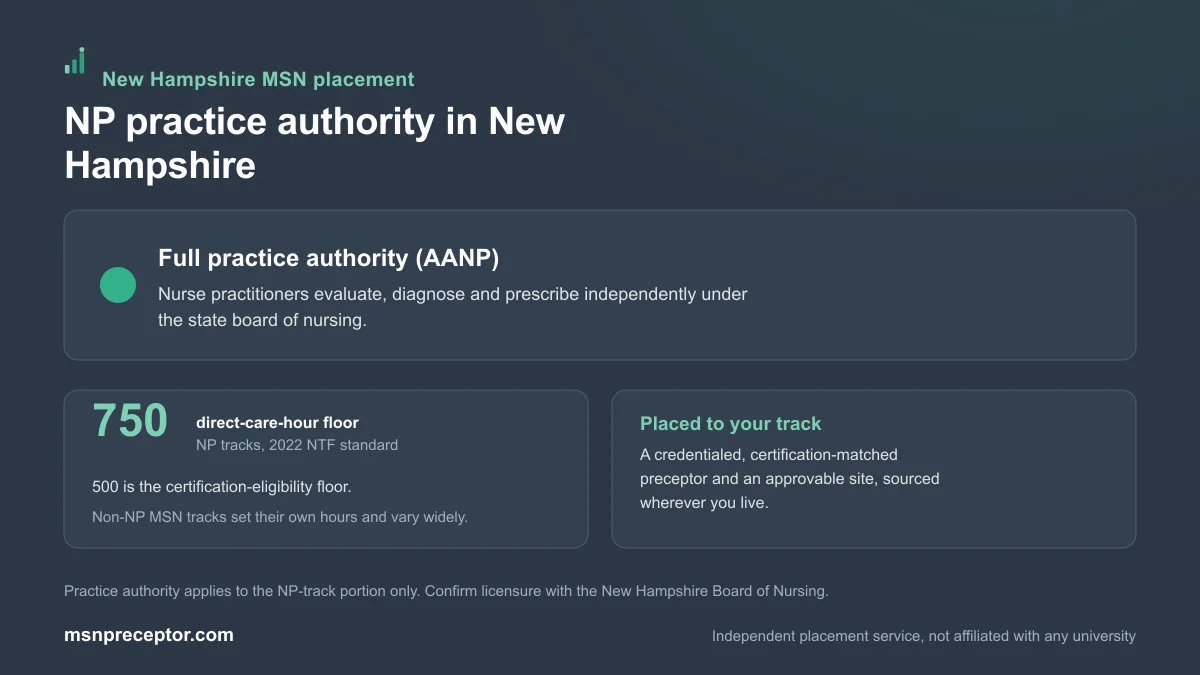
New Hampshire is an AANP full-practice state and has been for years. A nurse practitioner evaluates, diagnoses, orders testing, and prescribes under the New Hampshire Board of Nursing, part of the Office of Professional Licensure and Certification, without a collaborating physician required by the state.
For your rotation that means a qualified New Hampshire-licensed NP can precept an NP student on their own authority. It does not change who qualifies: the preceptor needs a current New Hampshire license and must practice in your population, and your program adds its own rules. Confirm licensure details with the board.
Hours follow your track, not the state. The 2022 National Task Force standards recommend a minimum of 750 direct-care hours per nurse practitioner track, national certification requires at least 500 faculty-supervised hours, and accredited NP programs commonly publish roughly 500 to 750 or more, many below 750. Non-NP tracks such as educator, informatics, and leadership generally run far lower, often about 100 to 200 hours. Simulation is excluded. Confirm your figure with your program; MSN clinical hours and NP hours by school lay out the ranges.
Plan on four to six months of lead time, and longer for the large academic system, where affiliation agreements can take a term. In the North Country, factor the drive and the seasons into your schedule.
We are independent, we work with MSN students at any university and across every track, and we run the outreach and paperwork so you are not cold-calling clinics and departments between shifts. We do not guarantee placement or your school's approval of any preceptor or site. Send your track and town and we will scope it at #match or through contact, and see how it works.
No. New Hampshire is a full-practice state, so a qualified nurse practitioner can practice and precept under their own license without a state-required collaborating physician. Your school can still add conditions, so confirm the preceptor's New Hampshire license and population match before you accept.
If you are logging a New Hampshire practicum, your preceptor generally needs a New Hampshire license and a New Hampshire site. Programs vary on out-of-state rotations, so check your handbook first, then we can target sites in the southern tier, the Seacoast, or wherever your program allows.
Yes. Educator, informatics, leadership, clinical nurse leader, and public-health students are matched to a mentor in that role. Informatics and leadership placements concentrate around the Upper Valley academic system and the Manchester and Concord hospitals, while educator practicum is more widely spread.
It depends on your track and program. NP tracks run into the hundreds of direct-care hours, with guidance recommending a minimum of 750 and certification requiring at least 500 faculty-supervised hours, while educator, informatics, and leadership tracks are far lower. Your handbook is the only authority on your number.
Last updated July 2026. Sources: AANP: New Hampshire state practice information; AANP: State Practice Environment; New Hampshire Board of Nursing (OPLC); Rural Health Information Hub: New Hampshire.
No cost to request. An advisor reviews the current course, pathway, location, and approval requirements before candidate sourcing begins.
We do not guarantee placement. Final approval rests with your program.
