An MSN practicum in Montana can look very different from one track to the next, and sorting out which one you are in is the first move. Nurse practitioner students need a direct-patient-care preceptor licensed in Montana, while educator, informatics, leadership, and clinical nurse leader students need an experienced mentor in that exact role, usually for far fewer hours. We are independent, we work with MSN students at any university, and we source and coordinate the site your program will recognize.
The Master of Science in Nursing is one degree with tracks that place in very different rooms, so the search starts with your track, not the school you attend. Our MSN specialties guide lays out how they diverge.
For the nurse practitioner tracks, Montana is a driving problem before it is a paperwork problem. Roughly 1.1 million people are spread across about 147,000 square miles, and clinical volume follows the interstates and a short list of hub cities: Billings, Missoula, Bozeman, Great Falls, Kalispell, Helena, and Butte.
Direct-care sites cluster in those hubs and thin out quickly between them. Federally qualified health centers, rural health clinics, and critical access hospitals carry much of the primary care, and the seven reservations add Indian Health Service and tribal health programs that make broad, full-lifespan rotations but take the longest to enter. Ask early about block scheduling and whether your school already holds an agreement with the site.
The non-NP tracks follow a different map. Educator practicum is the most evenly spread, because the state's nursing programs and community colleges run campuses well beyond Billings, so a qualified faculty mentor may sit closer to you than any clinic would.
Informatics and executive-leadership mentors are scarcer, and they concentrate in the handful of larger systems in Billings, Missoula, Kalispell, Great Falls, and Helena, where analytics, clinical-systems, and nurse-executive roles actually exist. Public and community health practicum runs through county and tribal health departments statewide. These tracks carry far fewer hours than the NP tracks, so one well-placed mentor often covers the entire requirement.
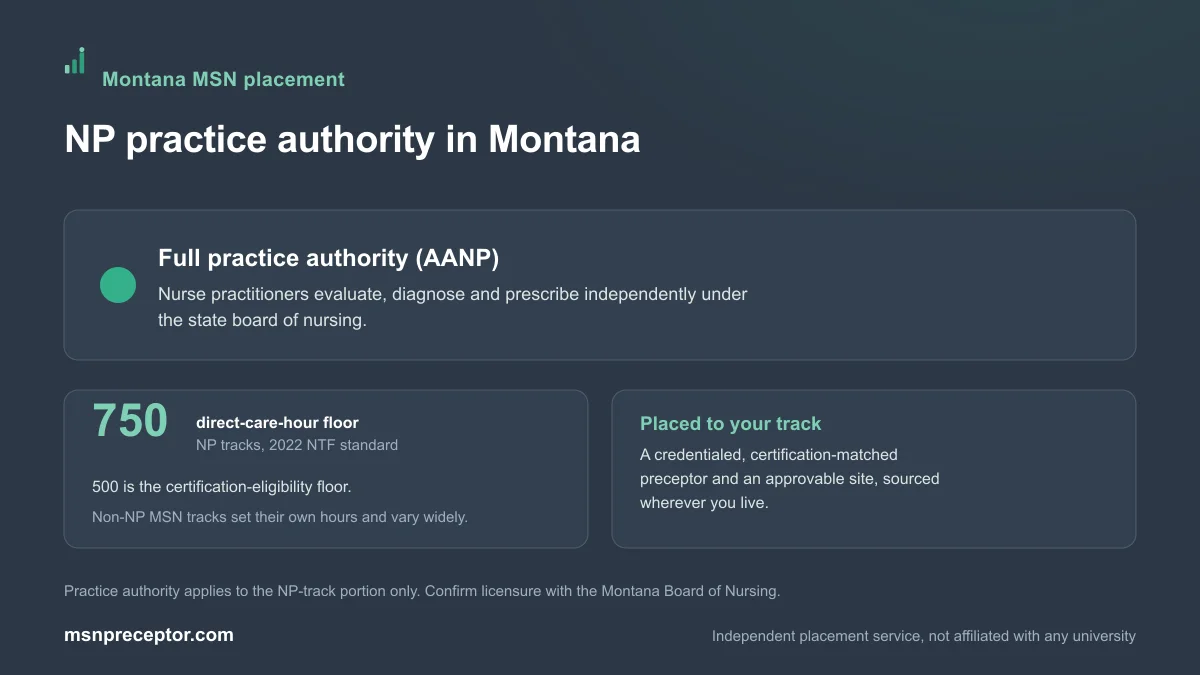
Montana sits in the AANP full-practice category. A nurse practitioner here evaluates, diagnoses, orders and interprets testing, and prescribes under the exclusive licensure authority of the Montana Board of Nursing, with no collaborating physician written into the arrangement.
For your rotation the effect is structural: a qualified Montana-licensed NP can precept an NP student on their own signature. That removes one hurdle, but it does not change who qualifies, since your preceptor must hold a current Montana license and practice in your population, and your program layers its own preceptor rules on top of the state's. Confirm licensure details with the board.
Hours depend on your track, not the state. The 2022 National Task Force standards recommend a minimum of 750 direct-care hours for each nurse practitioner track, national certification requires at least 500 faculty-supervised hours, and accredited NP programs commonly publish figures from roughly 500 to 750 or more, with a real share below 750. Non-NP tracks such as educator, informatics, and leadership usually run far lower, often in the range of about 100 to 200 hours. Simulation does not count. Read your handbook and confirm the number with your program; MSN clinical hours and NP hours by school explain the ranges.
Give yourself four to six months in Montana, and longer for a tribal site or a large system, where affiliation agreements can take a full term. Small clinics are interruptible when a provider is out, so build in buffer and log your hours as you go.
We are independent, we work with MSN students at any university and across every track, and we run the outreach and paperwork so you are not cold-calling clinics and departments between shifts. We do not guarantee placement or your school's approval of any preceptor or site. Tell us your track and county and we will scope it. Start at #match or reach us through contact, and see how it works.
No. Montana is in the AANP full-practice category, so a qualified nurse practitioner can practice and precept under their own license with no collaborating or supervising physician required by the state. Your school can still add conditions, so confirm the preceptor's Montana license and population match before you commit.
Yes. We place educator, informatics, leadership, clinical nurse leader, and public-health students with a mentor who holds that exact role, such as a nurse educator, informaticist, or nurse executive. These practicums usually carry far fewer hours than the NP tracks and are matched to the role rather than to prescribing.
It depends on your track and program. Nurse practitioner tracks run into the hundreds of direct-care hours, with national guidance recommending a minimum of 750 and certification requiring at least 500 faculty-supervised hours, while published totals commonly land between about 500 and 750 or more. Non-NP tracks are far lower. Your own handbook is the only authority on your number.
They concentrate in the larger systems in Billings, Missoula, Kalispell, Great Falls, and Helena, where analytics, clinical-systems, and nurse-executive roles exist. Educator practicum is more spread out across the state's nursing programs and community colleges, and public-health practicum runs through county and tribal health departments.
Last updated July 2026. Sources: AANP: Montana state practice information; AANP: State Practice Environment; Montana Board of Nursing: APRN licensure; Rural Health Information Hub: Montana.
No cost to request. An advisor reviews the current course, pathway, location, and approval requirements before candidate sourcing begins.
We do not guarantee placement. Final approval rests with your program.
