An MSN covers many tracks, and each places differently in Missouri. Nurse practitioner students need a direct patient care preceptor licensed in the state, and because Missouri is a restricted practice state, a collaborating physician is almost always part of that arrangement. The non-NP tracks, meaning nurse educator, informatics, leadership, clinical nurse leader, and public health, need a qualified mentor in the role instead, for far fewer hours.
Your track, not your town, sets the search in Missouri. The nurse practitioner tracks are direct patient care and need a board certified NP or physician preceptor. The non-NP tracks need an experienced mentor already in that role and carry a much lighter hour load.
Getting the track straight first tells you both the pool of qualifying preceptors and the paperwork your school will want.
Family practice is the workhorse, and safety net primary care runs deep. Missouri has a large number of rural health clinics and federally qualified health center sites serving both city neighborhoods and thinly populated counties, and their broad panels host NP students across the population span.
St. Louis and Kansas City hold the most clinics and the heaviest student competition. Springfield, Columbia, Joplin, Cape Girardeau, St. Joseph, and Jefferson City anchor regional care with a lighter load, and the Ozarks and the southeastern Bootheel have willing preceptors but longer drives to the nearest qualifying site. Access at the biggest systems can depend on a school affiliation agreement, while independent practices and health centers decide for themselves.
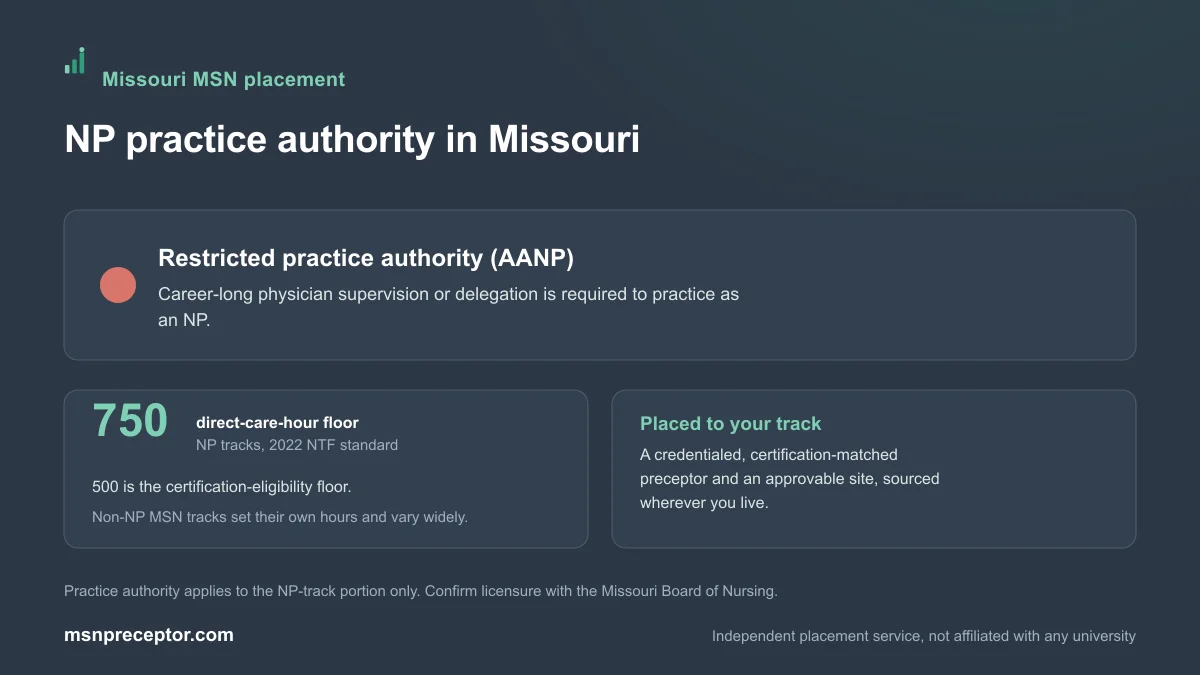
The AANP classifies Missouri as a restricted practice state. Nurse practitioners here do not practice independently; they work under a collaborative practice arrangement with a physician, defined in state statute and board rule, so a collaborating physician is part of the NP site you join.
A few specifics decide whether a site can take you. State rules limit a collaborating physician to six full time equivalent advanced practice nurses or physician assistants, set distance and chart review requirements, and start a new arrangement with a period of on site physician presence. That cap is what students hit without knowing why, since a practice already at the limit has no room. The upside is that physicians commonly precept NP students here, so your pool includes MDs and DOs. Your preceptor must be licensed in Missouri, in good standing, and practicing in your population. None of this touches the non-NP tracks. Verify current rules with the Missouri State Board of Nursing.
Missouri is stronger than it looks for the non-NP tracks, because St. Louis is a national headquarters city for several large health systems, and both St. Louis and Kansas City hold sizable analytics and clinical systems operations. Informatics and leadership practicum, which are hard to place in many states, have real homes in those metros.
Informatics students shadow clinical systems and analytics teams; leadership students shadow nurse executives and operations directors in the same organizations. Nurse educator hours follow the state's universities and community college nursing programs, which sit statewide, plus hospital professional development departments. Public and community health practicum run through county and city health departments.
As with any specialized role, these placements follow the right mentor and a defined project, so a student outstate may still work with a St. Louis or Kansas City team, which is routine.
No single figure fits everyone. NP tracks follow the 2022 National Task Force recommendation of a minimum of 750 direct patient care hours, with AANP or ANCC certification requiring at least 500 faculty supervised hours; accredited NP programs commonly publish totals from roughly 500 to 750 or more, and a meaningful number sit below 750, so confirm rather than assume.
The non-NP tracks carry far fewer, generally in the range of roughly 100 to 200 practicum hours set by each program, with the rest of the degree in coursework and projects. Your clinical handbook is the source of truth. Our MSN clinical hours page covers planning backward from your term.
We are an independent placement service for MSN students at any university, independent of any school, covering the whole state from St. Louis to the Bootheel. We work the phones and target the exact preceptor or mentor your track needs, and for NP students we account for the collaborating physician and the six APRN cap a restricted state builds in.
We do not promise placement, and your program has the final say on any preceptor or site. Read how it works and our cost page, then send your track, county, and term dates through #match or contact.
The limit often sits on the physician side. Missouri caps a collaborating physician at six full time equivalent advanced practice nurses or physician assistants and sets chart review requirements, so a practice already at that cap may simply have no room for another student arrangement.
In many program arrangements, yes. Because Missouri nurse practitioners work under a collaborative arrangement with a physician, MDs and DOs are frequently approved as preceptors, alongside board certified NPs. Your school sets the final rule.
Yes. St. Louis is a national headquarters city for several large health systems, and both St. Louis and Kansas City hold sizable analytics and clinical systems teams, so informatics and leadership mentors are more available here than in many states.
It depends on your track and program, not the state. NP tracks follow a recommended minimum of 750 direct care hours with certification requiring at least 500, while education, informatics, leadership, and CNL tracks commonly run roughly 100 to 200. Confirm your total in your handbook.
Last updated July 2026. Sources: AANP State Practice Environment; AANP Missouri state policy page; AANP Nurse Practitioner State Practice Environment chart; Missouri State Board of Nursing: APRN collaborative practice; Missouri Revised Statutes, Section 334.104; Rural Health Information Hub: Missouri; ANCC nurse practitioner certification.
No cost to request. An advisor reviews the current course, pathway, location, and approval requirements before candidate sourcing begins.
We do not guarantee placement. Final approval rests with your program.
