An MSN spans several tracks, and each one places differently in Mississippi. Nurse practitioner students need a direct patient care preceptor licensed in the state, and because Mississippi is a reduced practice state, that preceptor practices under a collaborative agreement with a physician. The non-NP tracks, meaning nurse educator, informatics, leadership, clinical nurse leader, and public health, need a qualified mentor in the role instead, for far fewer hours.
Mississippi placement starts with your track, because that decides what a qualifying preceptor or mentor looks like. The nurse practitioner tracks need direct patient care with a board certified NP or physician. The non-NP tracks need an experienced professional already in that function and carry far fewer hours.
Because Mississippi has fewer large systems than most states, naming your track early matters even more, since the right mentor may sit in only a handful of places.
Family practice carries much of the load, and safety net primary care is unusually important here. The state relies on a network of more than twenty federally qualified health centers, plus rural health clinics certified through the state health department, and those broad panels host NP students across the population span.
The clinical map has a few anchors. Jackson holds the state's only academic medical center and the deepest concentration of specialty care and health system roles. The Gulf Coast around Gulfport and Biloxi, Hattiesburg in the south, Tupelo and the northeast, and the Golden Triangle each anchor regional care. The Delta and the rural counties in between have real preceptor willingness but thin supply, so distance is the usual constraint.
Confirm how your program counts a given setting, and remember that access at the larger systems can run through a school affiliation agreement while independent clinics decide on their own.
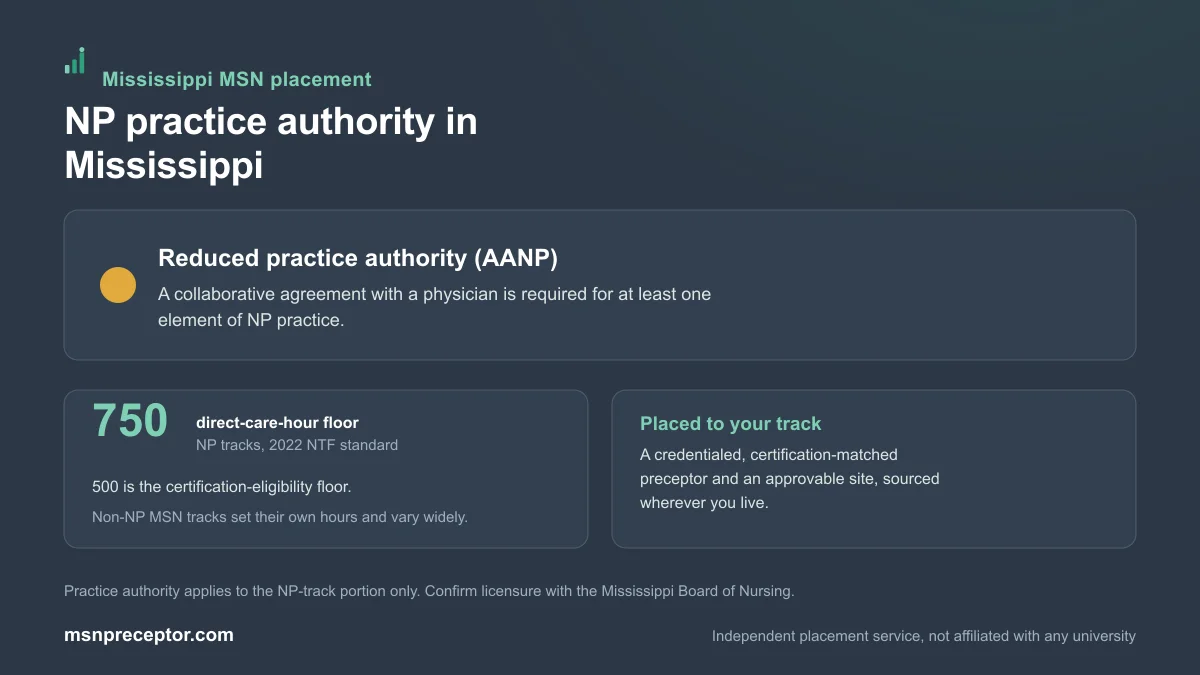
The AANP classifies Mississippi as a reduced practice state. Every advanced practice nurse here works under a collaborative agreement with a licensed Mississippi physician, and that physician is listed on the board record, so a supervising or collaborating physician is built into the NP site you join. A recent effort to move the state toward independent practice did not pass, so plan around the current rule.
This shapes who signs off, not what you learn. Physicians commonly precept NP students in Mississippi, which widens your pool to include MDs and DOs alongside NPs. Your preceptor must be licensed in Mississippi, in good standing, and practicing in the population you log. Reduced practice does not touch the non-NP tracks, whose mentors are educators, informaticists, and executives rather than prescribers. Verify current requirements with the Mississippi Board of Nursing.
The tracks no specialty site covers place differently here. Informatics and leadership practicum concentrate where the larger systems are, so Jackson, the Gulf Coast, Hattiesburg, and Tupelo hold most of the clinical systems, analytics, and nurse executive roles a student would shadow.
Nurse educator hours follow the state's universities and community college nursing programs, which are spread across the state, along with hospital staff development departments. Public and community health practicum run through the state health department districts and county offices, a genuinely broad option in Mississippi given its public health footprint.
Because these mentors are fewer, the search is about the right person and a defined project rather than the closest building, and a student may travel or work partly at a distance to reach the right fit.
There is no single Mississippi number. NP tracks follow the 2022 National Task Force recommendation of a minimum of 750 direct patient care hours, with AANP or ANCC certification requiring at least 500 faculty supervised hours; accredited NP programs commonly publish totals from roughly 500 to 750 or more, and many sit below 750, so do not assume the highest figure.
The non-NP tracks carry far less, generally in the range of roughly 100 to 200 practicum hours set by each program. Work from your clinical handbook, since that number drives your timeline. See MSN clinical hours for planning the sequence.
We are an independent placement service for MSN students at any university, independent of any school, working every track statewide from the Delta to the Gulf Coast. We handle the outreach and target the exact preceptor or mentor your track needs, and for NP students we account for the physician collaboration a reduced state requires.
We do not guarantee placement, and your program makes the final call on any preceptor or site. Read how it works and our cost page, then send your track, county, and term dates through #match or contact.
Frequently, yes. Because Mississippi nurse practitioners work under a collaborative agreement with a physician, MDs and DOs are often approved as preceptors for NP students, alongside board certified NPs. Your program sets the final rule.
Often in family practices and the state's federally qualified health centers and rural health clinics, which run broad panels. Jackson holds the deepest specialty care, while the Delta and rural counties have willing preceptors but longer drive times.
Yes. We place nurse educator, informatics, leadership, clinical nurse leader, and public health students as well as the NP tracks. Those practicums use a qualified mentor in the role and carry far fewer hours than the NP tracks.
It depends on your track and program, not the state. NP tracks follow a recommended minimum of 750 direct care hours with certification requiring at least 500, while education, informatics, leadership, and CNL tracks commonly run roughly 100 to 200. Confirm the figure in your handbook.
Last updated July 2026. Sources: AANP State Practice Environment; AANP Mississippi state policy page; AANP Nurse Practitioner State Practice Environment chart; Mississippi Board of Nursing; Mississippi State Department of Health: Qualified Health Center program; Mississippi State Department of Health: Rural Health Clinics; ANCC nurse practitioner certification.
No cost to request. An advisor reviews the current course, pathway, location, and approval requirements before candidate sourcing begins.
We do not guarantee placement. Final approval rests with your program.
