An MSN is one degree with several tracks, and Minnesota fits all of them, though each places differently. Nurse practitioner students need a direct patient care preceptor licensed in the state, while nurse educator, informatics, leadership, clinical nurse leader, and public health students work with an experienced mentor in the role for far fewer hours. Minnesota is a full practice authority state, which mainly shapes the supervision arrangement for the NP tracks.
The practicum you need depends on your track, not just your address, so start there. The nurse practitioner tracks are direct patient care and need a board certified NP or physician preceptor. The non-NP tracks need a qualified mentor already in the role and carry a much lighter hour load.
Once your track is clear, the setting, the mentor, and the hour count all follow from it.
Minnesota is one of the stronger states in the country for the non-NP MSN tracks, because the Twin Cities hold an unusual concentration of large health systems plus some of the nation's biggest health insurance and analytics employers. That makes informatics and leadership practicum, which many students struggle to place elsewhere, genuinely findable here.
Informatics students shadow clinical systems, analytics, and electronic record teams inside those organizations. Leadership students shadow nurse executives and operations directors in the same systems. The medical campus in Rochester adds a second hub for informatics, research, and clinical education roles. Nurse educator hours follow the state's universities and community college nursing programs, which sit statewide, along with hospital professional development departments. Public and community health hours run through county and state health agencies.
These placements are about matching the right mentor and a defined project, so a Duluth or Rochester student may still work with a Twin Cities team, and that is routine.
For the NP tracks, the clinical sites spread across the whole state. Primary care groups, pediatric and women's health practices, behavioral health clinics, federally qualified health centers, and long term care all host students, matched to your population.
The Minneapolis and Saint Paul metro carries the most volume and the heaviest student demand. Rochester, Duluth, St. Cloud, Mankato, and Moorhead anchor regional care with lighter competition, and the Iron Range and rural counties often have willing preceptors but longer drives to the nearest qualifying site. As elsewhere, access to the biggest systems runs through your school's affiliation agreement, while independent clinics and health centers can decide on their own.
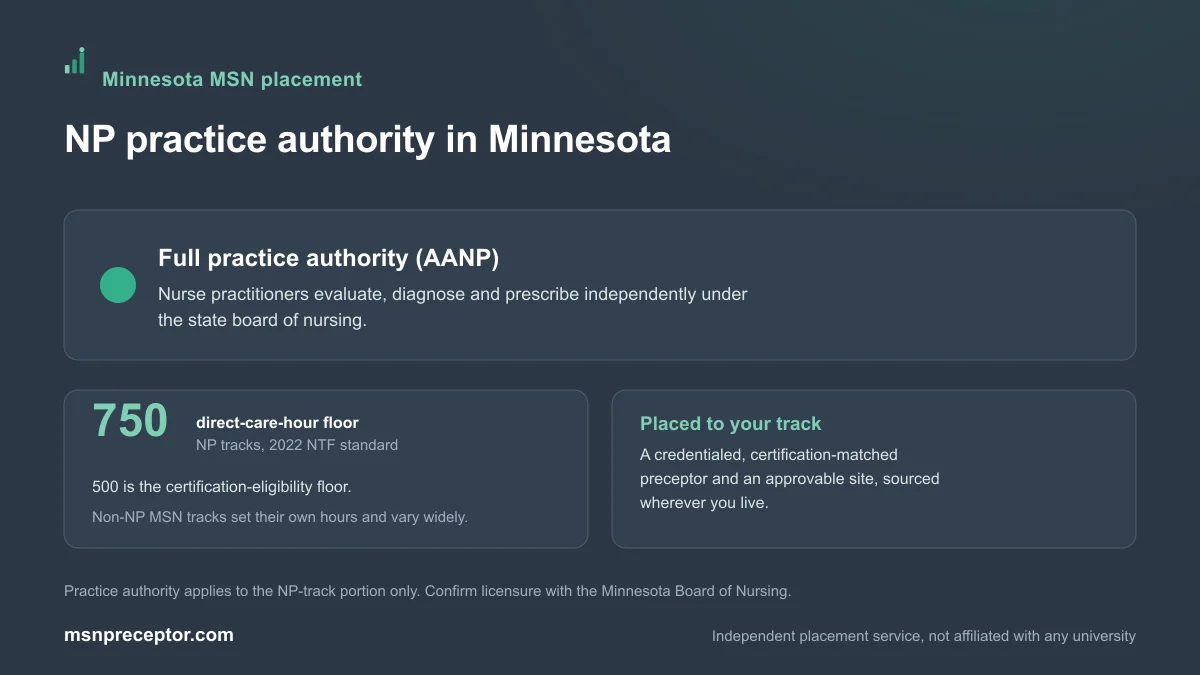
The AANP classifies Minnesota as a full practice state. A nurse practitioner here evaluates, diagnoses, treats, and prescribes under the authority of the Minnesota Board of Nursing, so an established NP can precept you without a collaborating physician written into the arrangement.
That tends to make the NP search cleaner than in a restricted state, since the decision sits with the practice rather than a physician agreement. It does not change the basics: your preceptor must be licensed in Minnesota, in good standing, and practicing in the population you log, and physicians may precept in many program arrangements. Practice authority does not touch the non-NP tracks, where an educator, informaticist, or executive mentor is what your program wants. Confirm accepted categories in your handbook.
No single hour figure fits every MSN student. NP tracks follow the 2022 National Task Force recommendation of a minimum of 750 direct patient care hours, with AANP or ANCC certification requiring at least 500 faculty supervised hours; accredited NP programs commonly publish totals from roughly 500 to 750 or more, and many fall below 750, so verify yours.
The non-NP tracks are much lighter, generally in the range of roughly 100 to 200 practicum hours set by each program, with the rest of the degree in coursework and applied projects. Your clinical handbook is the source of truth. Our MSN clinical hours page shows how to plan backward from graduation.
We are an independent placement service for MSN students at any university, independent of any school, working every track across Minnesota from the Twin Cities to the Iron Range. We take on the outreach and target the exact preceptor or mentor your track requires, whether that is a family NP, an informatics team, or a nurse executive.
We do not guarantee placement, and your program approves the final preceptor or site. Read how it works and our cost page, then send your track, county, and term dates through #match or contact.
Yes, it is one of the better ones. The Twin Cities concentrate large health systems and major health insurance and analytics employers, and the Rochester medical campus adds another hub, so informatics and leadership mentors are more available here than in many states.
It can. Minnesota is a full practice state, so an established nurse practitioner precepts under the Minnesota Board of Nursing with no collaborating physician required in the arrangement. The decision sits with the practice, which often makes the search cleaner.
Yes. We place the nurse practitioner tracks plus nurse educator, informatics, leadership, clinical nurse leader, and public health students. The mentor, setting, and hour count differ by track, and we match each one accordingly.
It depends on your track and program, not the state. NP tracks follow a recommended minimum of 750 direct care hours with certification requiring at least 500, while education, informatics, leadership, and CNL tracks commonly run roughly 100 to 200. Confirm your total in your handbook.
No cost to request. An advisor reviews the current course, pathway, location, and approval requirements before candidate sourcing begins.
We do not guarantee placement. Final approval rests with your program.
