An MSN covers many tracks, and each one places differently in Michigan. Nurse practitioner students need a direct patient care preceptor licensed in the state, and because Michigan is a restricted practice state, a physician is usually part of that arrangement. The non-NP tracks, meaning nurse educator, informatics, leadership, clinical nurse leader, and public health, need a qualified mentor in the role instead, for far fewer hours.
Before you look at a single clinic, decide what your track actually requires, because an MSN practicum in Michigan takes two different shapes. Nurse practitioner tracks are direct patient care and need a board certified NP or physician preceptor. The non-NP tracks need an experienced mentor already doing that job, and they carry a much smaller number of hours.
Naming your track first saves weeks, because the pool of qualifying preceptors and the paperwork your school wants both change with it.
The direct care sites are spread statewide. Family and internal medicine practices, pediatric and women's health offices, behavioral health clinics, federally qualified health centers, urgent care, and long term care all host NP students, matched to the population on your transcript.
Metro Detroit holds the most clinics and the most competition, since it also trains the most students. Grand Rapids, Ann Arbor, Lansing, Kalamazoo, and Flint each anchor real clinical volume with a lighter student load, and the large multi hospital systems based in Grand Rapids and Detroit run broad outpatient networks. Push north into the rural Lower Peninsula and the Upper Peninsula and willingness rises while the nearest qualifying site gets farther away, so travel becomes the real cost.
Because affiliation agreements gate access at the biggest systems, an independent practice or a health center often clears faster. Confirm how your program counts a given setting before you commit.
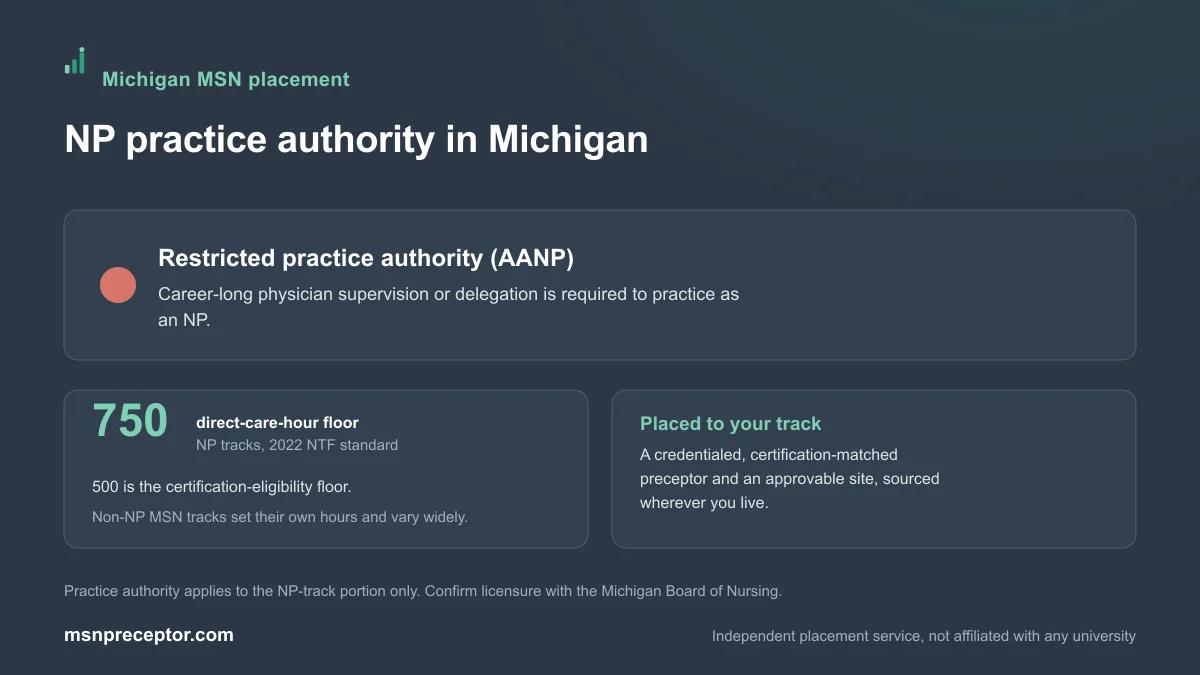
The AANP classifies Michigan as a restricted practice state. Nurse practitioners here practice under a required relationship with a physician rather than independently, so at most NP sites a collaborating or supervising physician is part of the structure you join. Legislation to grant full practice authority has been introduced but has not become law, so plan around the current rule.
In practice this shapes who signs off, not what you learn. Physicians frequently precept NP students in Michigan, which actually widens your preceptor pool to include MDs and DOs alongside NPs. Whoever it is, your preceptor must be licensed in Michigan, in good standing, and practicing in the population you are logging. The non-NP tracks are unaffected by practice authority, since those mentors are educators, informaticists, and executives, not prescribers. Verify current requirements with the Michigan Board of Nursing, which sits under the state licensing department.
Michigan has deep infrastructure for the tracks no specialty site handles. Nursing informatics and leadership practicum concentrate in the large health systems clustered in metro Detroit, Grand Rapids, and Ann Arbor, where clinical informatics, analytics, and nurse executive offices are big enough to host a student in a defined project.
Nurse educator hours follow the state's many universities and community college nursing programs, plus hospital professional development departments, and those exist in nearly every region, not only the metros. Public and community health practicum run through county and city health departments statewide.
These placements turn on the right mentor rather than the closest address. An informatics student may work with a clinical systems team in Grand Rapids while living downstate, because that is where the role and the project fit. That is expected, and we plan for it.
The number you owe comes from your program. For NP tracks, the 2022 National Task Force standards recommend a minimum of 750 direct patient care hours, and AANP or ANCC certification requires at least 500 faculty supervised hours; accredited NP programs commonly publish anywhere from roughly 500 to 750 or more, and many land below 750, so confirm rather than assume.
Non-NP tracks carry far less. Nurse educator, informatics, leadership, and clinical nurse leader practicums generally run in the range of roughly 100 to 200 hours, defined by each program, with the rest of the degree in coursework and applied projects. Start from your clinical handbook and its per course minimums. See MSN clinical hours for how to plan the sequence.
We are an independent service for MSN students at any university, not tied to any school, covering the whole state from the Detroit metro to the Upper Peninsula. We do the outreach and target the exact preceptor or mentor your track needs, and for NP students we account for the physician relationship a restricted state requires.
We never promise placement, and your program has the final say on any preceptor or site. Look over how it works and the cost page, then send your track, county, and term dates through #match or contact.
Often yes. Because Michigan nurse practitioners practice in a required relationship with a physician, MDs and DOs are frequently approved as preceptors for NP students, alongside board certified NPs. Your program sets the final rule on who qualifies.
Yes. We place nurse educator, informatics, leadership, clinical nurse leader, and public health students as well as the NP tracks. Those practicums use a qualified mentor in the role and carry far fewer hours than the NP tracks.
In the large health systems around metro Detroit, Grand Rapids, and Ann Arbor, where clinical informatics and nurse executive teams are big enough to host a student project. The search follows the right mentor, so living nearby helps but is not required.
That depends on your track and program. NP tracks follow a recommended minimum of 750 direct care hours with certification requiring at least 500, while education, informatics, leadership, and CNL tracks commonly run roughly 100 to 200. Check your handbook for the exact figure.
No cost to request. An advisor reviews the current course, pathway, location, and approval requirements before candidate sourcing begins.
We do not guarantee placement. Final approval rests with your program.
