An MSN is a single degree with very different practicum needs depending on your track, and Massachusetts supports the whole range. Nurse practitioner students need a direct patient care preceptor licensed in the state, while nurse educator, informatics, leadership, and public health students work with an experienced mentor in that role for far fewer hours. Massachusetts is a full practice authority state, which mainly shapes the supervision picture for the NP tracks, not the law that lets a site say yes.
The first question is not which town you live in, it is which MSN track you are completing, because that decides what a qualifying preceptor or mentor even looks like. The nurse practitioner tracks all require hands on direct patient care. The non-NP tracks need a seasoned professional already working in that function, and they carry a much lighter hour load.
Name the track first and the rest of the search, the setting, the mentor, and the hour count, falls into place. We place all of them.
Every NP track needs its hours in real primary or specialty care, and in Massachusetts that work sits in ordinary community practice rather than the famous teaching hospitals. Community health centers do a large share: the members of the state's community health center league serve more than a million residents across most of its communities, and they see the full lifespan in one building.
Family and internal medicine groups, pediatric practices, obstetrics and gynecology offices, behavioral health clinics, urgent care, college student health, and home based primary care all host NP students, depending on the population you log. The catch with the big Boston systems is access: an individual clinician there often cannot say yes without an affiliation agreement between your school and the system, while an independent practice or health center can decide on its own.
Most clinical volume sits in Greater Boston, which is also where student demand runs heaviest, since several health professions programs draw from the same pool. Worcester, Springfield, the Berkshires, the Cape, and the Islands see far less traffic, and federal shortage designations cluster in exactly those areas, so a preceptor is often easier to find there if you can absorb the drive.
This is the part no single specialty site covers, and Massachusetts is unusually rich in it. Informatics and leadership practicum concentrate where the large systems are, so Greater Boston, Worcester, and Springfield hold most of the analytics teams, clinical systems groups, and nurse executive offices a student would shadow.
Nurse educator hours follow the schools instead. The state has a dense network of universities and community colleges with nursing programs, plus hospital based professional development and clinical education departments, and those are your educator sites statewide, not only in the metro. Public and community health hours run through municipal and state health departments, which sit in most cities and larger towns.
Because these mentors are fewer than clinicians and the roles are specialized, the search is about the right person, not the nearest building. A leadership student may shadow a chief nursing officer an hour away because that is where the right executive practices, and that is normal.
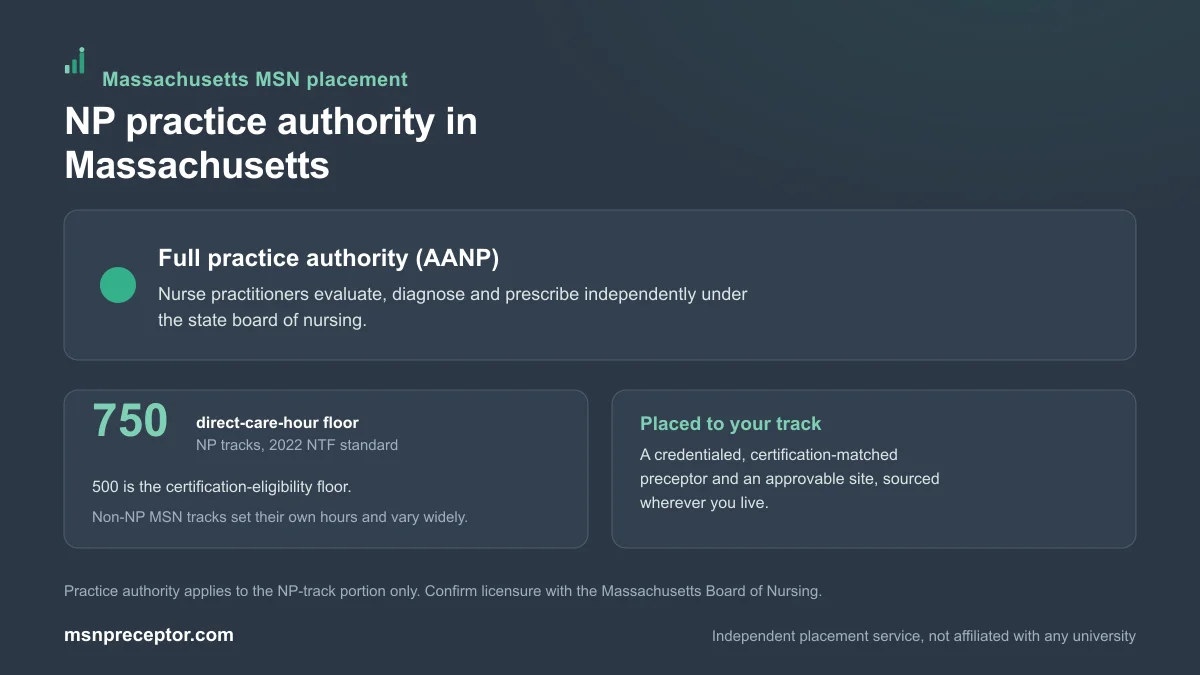
The AANP classifies Massachusetts as a full practice state. A nurse practitioner here evaluates, diagnoses, treats, and prescribes under the authority of the Board of Registration in Nursing, so an established NP can precept you under their own signature, with no collaborating physician written into the arrangement.
One detail affects who is available. Massachusetts reached full practice through Chapter 260 of the Acts of 2020, and board regulations at 244 CMR 4.00 still require a newly certified NP to complete a period of supervised practice before practicing independently, so preceptors here tend to be experienced. None of this touches the non-NP tracks, where a qualified educator, informaticist, executive, or CNL mentor is what your program is looking for. Confirm accepted preceptor categories in your handbook and licensure with the board.
There is no single number, and this is where students trip. The 2022 National Task Force standards recommend a minimum of 750 direct patient care hours for each NP track, and certification through AANP or ANCC requires at least 500 faculty supervised hours; accredited NP programs commonly publish totals from roughly 500 to 750 or more, and a good many sit below 750, so do not assume yours is the highest figure.
The non-NP tracks are a different world. Nurse educator, informatics, leadership, and clinical nurse leader practicums usually run in the range of roughly 100 to 200 hours, set by each program, with the balance of the degree in coursework and projects. Whatever your track, work from your own clinical handbook, since that number drives your whole timeline. Our MSN clinical hours guide walks through planning backward from your term.
We are an independent placement service for MSN students at any university, independent of any school, working every track from the North Shore to the Berkshires. We take the cold outreach off your plate and target the specific preceptor or mentor your track needs, whether that is an NP in a Boston health center or a nurse executive in Springfield.
We do not guarantee placement, and your program makes the final call on any preceptor or site. Read how it works and our cost page, then send your track, county, and term dates through the form at #match or reach us at contact.
No. We place every MSN track, including nurse educator, informatics, leadership, clinical nurse leader, and public health students, alongside the nurse practitioner tracks. The mentor and setting differ by track, and so does the hour count.
Yes. Massachusetts is a full practice authority state, so an established nurse practitioner precepts under the Board of Registration in Nursing with no collaborating physician in the arrangement. Newly certified NPs are still finishing a supervised practice period, so preceptors here skew experienced.
Inside health systems. Informatics practicum sit with clinical systems and analytics teams, and leadership practicum shadow nurse executives and operations leaders. In Massachusetts those roles concentrate in Greater Boston, Worcester, and Springfield, so the search follows the right mentor rather than the nearest hospital.
It depends on your track and your program, not the state. NP tracks follow a recommended minimum of 750 direct care hours with certification requiring at least 500, while education, informatics, leadership, and CNL tracks commonly run roughly 100 to 200. Confirm your exact total in your handbook.
No cost to request. An advisor reviews the current course, pathway, location, and approval requirements before candidate sourcing begins.
We do not guarantee placement. Final approval rests with your program.
