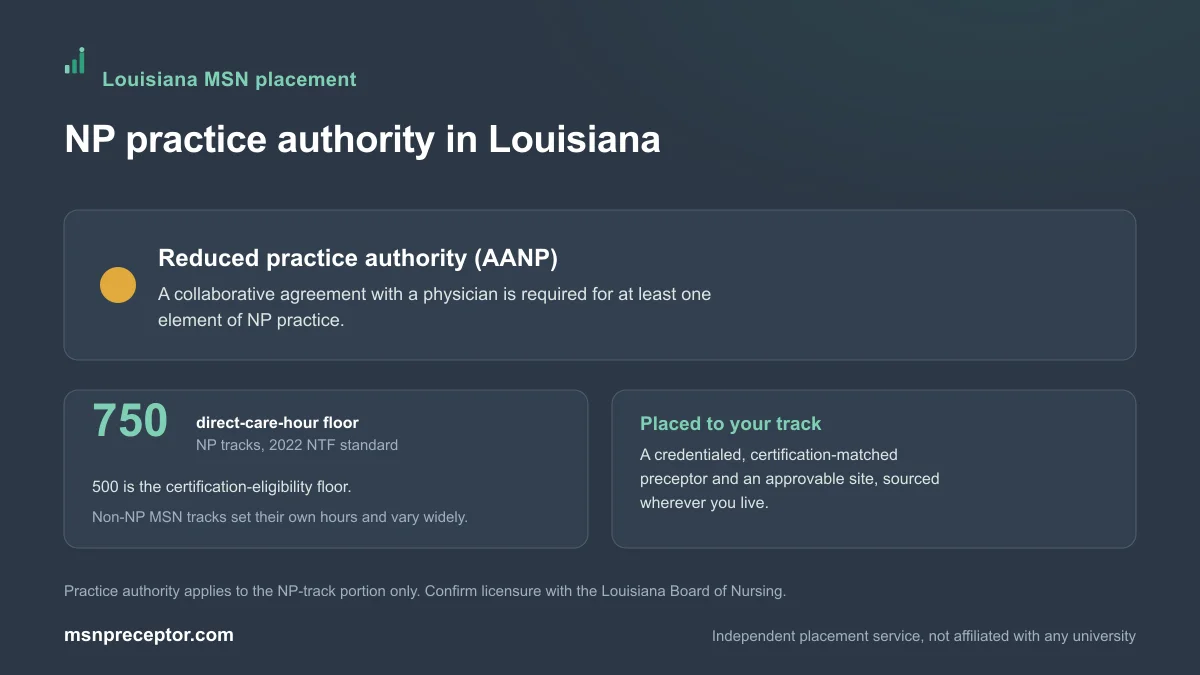
Louisiana is a reduced practice authority state, so nurse practitioners here work under a collaborative agreement with a physician, a detail that shapes NP supervision but has little to do with the many MSN students on non-NP tracks. Nurse educator, informatics, leadership, and clinical nurse leader practicums place in Louisiana too, mostly around the health systems in New Orleans, Baton Rouge, Shreveport, and Lafayette. This page maps where each track goes and how we help you land a site.
MSN is an umbrella degree, and the practicum you need depends on your track. The nurse practitioner tracks require a direct patient care preceptor. The non-NP tracks require a qualified mentor in a teaching, technology, or management role, and they carry far fewer hours. Louisiana hosts both, and they sit in different settings.
Single NP specialties are covered in depth by our sibling desks. Here the whole degree stays in frame, because the placement task is not the same across tracks.
For the NP tracks, clinical volume and competition concentrate in the metros. Greater New Orleans, anchored by the large integrated system based in the city, holds the most sites and the most competing students. Baton Rouge is the second center, with Shreveport in the northwest, Lafayette across Acadiana, and Lake Charles and Monroe rounding out the regions.
The rural Delta parishes and stretches of Acadiana are more thinly served, and care there runs through community health centers, rural health clinics, and smaller hospitals. Preceptors are often willing outside the metros, and the cost is yours in drive time. Psychiatric-mental health and pediatric hours are the ones that most often stall students, since dedicated sites cluster in the cities while rural clinics fold both into family practice.
For how a single specialty behaves on its own, see our MSN specialties guide.
Nursing informatics and health-systems leadership practicums are easiest to arrange where analytics teams and executive offices actually exist, and in Louisiana that means the larger systems in New Orleans and Baton Rouge, plus the academic system in Shreveport and the Lafayette hospitals. A student shadowing a nurse executive or sitting with a clinical-systems team needs an organization big enough to have those roles.
Nurse educator practicum follows the schools of nursing and community and technical college nursing programs, which reach well beyond the metros and can host a student teaching under a qualified faculty member. Hospital staff-development departments add more options. Because these tracks carry far fewer hours, a single placement usually finishes the requirement.
Public and community health practicums sit with parish and regional health units and community health centers, which extend into the rural parishes more evenly than the analytics teams do.
Louisiana is a reduced practice state. Nurse practitioners practice under a collaborative practice agreement with a physician that is reviewed annually, with the collaborating physician reachable but not required on site. Full practice legislation has been introduced but not enacted, so the arrangement stands. The American Association of Nurse Practitioners lists Louisiana as reduced, and licensure sits with the Louisiana State Board of Nursing.
For a student, this changes less than it sounds. An NP preceptor in Louisiana typically works under a collaborative agreement of their own, but that does not prevent them from precepting you; you still need a board-certified NP, or a physician, practicing in your track and population. For the non-NP tracks, the collaborative-agreement rules do not apply, because your mentor is an educator, informaticist, or nurse executive.
Do not assume a number. For NP tracks, the 2022 National Task Force standards recommend a minimum of 750 direct patient care hours per track, and certification eligibility requires at least 500 faculty-supervised hours; accredited programs commonly publish somewhere between 500 and 750 or more, and many sit below 750. Non-NP tracks carry far fewer, commonly around 100 to 200 practicum hours. Simulation does not count toward direct-care totals. Confirm your own number in your handbook, and see MSN clinical hours.
The affiliation agreement between your school and the site is usually the slow step, not the preceptor. Independent clinics and small rural practices in Louisiana may never have signed one with your university, and legal review can take weeks, so raise it in the first conversation. A site already hosting students from your program generally has one in place.
If you have run your own contacts and come up short, that is our job. We are an independent placement service, separate from any university, and we help MSN students from any program and on any track. We match on your track, the role or populations you need, the part of Louisiana you can reach, and your start window. We do not guarantee placement, and your school always decides whether to approve a given preceptor or site.
Send your track, your city, and your term dates through the match form on this page or through contact. For the mechanics first, see how it works and cost.
Reduced. The American Association of Nurse Practitioners lists Louisiana as reduced practice. NPs work under a collaborative practice agreement with a physician that is reviewed annually. Full practice bills have been introduced but not enacted. Confirm current licensure rules with the Louisiana State Board of Nursing.
Yes. Nurse educator, informatics, leadership, and clinical nurse leader students place in schools of nursing, health-system IT and analytics teams, and executive offices, mentored by an experienced person in that role rather than a prescriber. These tracks carry far fewer hours than NP programs and often fit a single site.
It depends on your track, not the state. NP tracks run into the hundreds of direct-care hours, guided by the 2022 National Task Force recommendation of at least 750 and a certification floor of 500 faculty-supervised hours, with many programs between those figures. Non-NP tracks commonly sit near 100 to 200. Confirm the exact total with your own program.
For NP direct-care hours, the rural parishes and Acadiana are often quicker to get a yes from and harder to actually do, because the metros hold more sites but far more competing students. Community health centers and smaller hospitals outside the cities have willing preceptors, and the trade is drive time.
No. We source approvable preceptors and mentors and handle the paperwork, but placement is never guaranteed, and final approval of any preceptor or site rests with your program. See how it works for what we do and do not promise.
Last updated July 2026. Sources: AANP State Practice Environment; AANP Louisiana state advocacy page; Louisiana State Board of Nursing; Louisiana Department of Health.
No cost to request. An advisor reviews the current course, pathway, location, and approval requirements before candidate sourcing begins.
We do not guarantee placement. Final approval rests with your program.
