Kentucky is a reduced practice authority state, which shapes how nurse practitioner supervision is arranged but says nothing about the many MSN students who are not on an NP track at all. The degree also covers nurse educators, informaticists, leaders, and clinical nurse leaders, and each places in different corners of the state with its own kind of mentor. Here is the full picture, from the Louisville and Lexington systems out to the Appalachian counties in the east.
MSN is a family of tracks, not a single program, so where you practicum depends on which one you are in. The nurse practitioner tracks need a direct patient care preceptor, but the non-NP tracks place in teaching, technology, and management settings that look nothing like an exam room. Kentucky supports all of them, in different parts of the state.
Our sibling desks handle single NP specialties in depth. This page holds the whole degree together, because the placement puzzle changes with the track.
Nursing informatics and health-systems leadership practicums are easiest to arrange where the analytics teams and executive offices actually sit, which in Kentucky means the two large systems in Louisville, the flagship academic system in Lexington, and the northern Kentucky organizations across the river from Cincinnati. A student needs an organization big enough to have a clinical-systems team or a nurse executive to shadow.
Nurse educator practicum follows the schools instead. Nursing programs at universities and community and technical colleges run across the whole state, and any can host a student teaching under a qualified faculty member, with hospital staff-development departments adding more options. Because these tracks carry far fewer hours than NP programs, one good placement usually covers the requirement.
Public and community health practicums place with county and district health departments and community health centers, which extend into the rural east and west more evenly than the analytics teams do.
For the NP tracks, the clinical volume and the competition both concentrate in the same three areas: Louisville and Jefferson County, Lexington and the central Bluegrass, and northern Kentucky. Bowling Green, Owensboro, and Paducah are useful regional hubs with real primary care and lighter student traffic.
Eastern Kentucky is the other story. The Appalachian counties are heavily designated as underserved, and care runs through a regional nonprofit system, Critical Access Hospitals, and community health centers. Preceptors there are often willing, and the cost is yours in mileage. Psychiatric-mental health and pediatric hours are the ones that most often stall students statewide, since dedicated sites cluster in the metros while rural clinics fold both into family practice.
For how one specialty behaves on its own, see our MSN specialties guide.
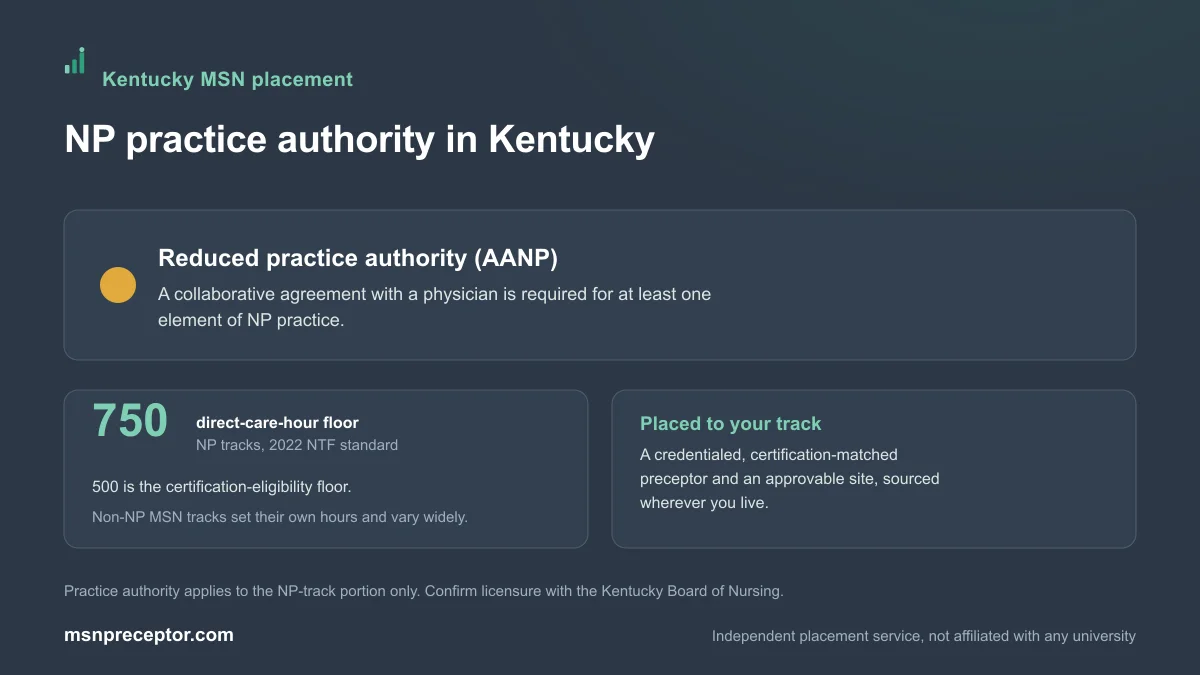
Kentucky is a reduced practice state. Nurse practitioners prescribe under collaborative agreements with a physician, one for non-scheduled medications and a separate one for controlled substances, and after four years of prescribing in good standing an NP can ask the board to drop each. The American Association of Nurse Practitioners lists Kentucky as reduced, and licensure sits with the Kentucky Board of Nursing.
For a student, the practical point is simple. An NP preceptor in Kentucky often works under one of these agreements, but that does not stop them from precepting you; your task is to line up a board-certified NP, or a physician, who practices in your track and population. For the non-NP tracks, the collaborative-agreement rules are beside the point, because your mentor is an educator, informaticist, or executive rather than a prescriber.
Do not assume a number. For NP tracks, the 2022 National Task Force standards recommend a minimum of 750 direct patient care hours per track, while certification eligibility requires at least 500 faculty-supervised hours; accredited programs commonly publish somewhere between 500 and 750 or more, and many sit below 750. Non-NP tracks carry far fewer, commonly around 100 to 200 practicum hours. Simulation is excluded from direct-care totals. Confirm your own figure in your handbook, and see MSN clinical hours.
The preceptor saying yes is rarely the slow part. The affiliation agreement between your school and the site is, especially at independent practices and small rural organizations that have never signed one with your university. Bring it up early, since legal review can take weeks, and check whether a site already hosts students from your program.
If your own outreach has stalled, that is where we come in. We are an independent placement service, separate from any university, and we work with MSN students from any program and on any track. We match on your track, the role or populations you still owe, the region you can reach, and your term dates. We never guarantee placement, and your school makes the final call on any preceptor or site.
Send your track, your city, and your start window through the match form on this page or through contact. To see the mechanics first, read how it works and cost.
Reduced. The American Association of Nurse Practitioners lists Kentucky as reduced practice. NPs prescribe under collaborative agreements with a physician, one for non-scheduled drugs and one for controlled substances, and after four years of prescribing in good standing may petition the Kentucky Board of Nursing to remove each. Confirm current rules with the board.
Yes. Nurse educator, informatics, leadership, and clinical nurse leader students place in schools of nursing, health-system IT and analytics teams, and executive offices, mentored by an experienced person in that role rather than a prescriber. These tracks carry far fewer hours than NP programs and often fit a single site.
It depends on your track, not the state. NP tracks run into the hundreds of direct-care hours, guided by the 2022 National Task Force recommendation of at least 750 and a certification floor of 500 faculty-supervised hours, with many programs between those figures. Non-NP tracks commonly sit near 100 to 200. Confirm the exact total with your own program.
Regional hubs like Bowling Green, Owensboro, and Paducah have working primary care and lighter competition, and eastern Kentucky's Appalachian counties rely on a regional system, Critical Access Hospitals, and community health centers. Preceptors there are often willing, and the trade is drive time.
No. We source approvable preceptors and mentors and carry the paperwork, but placement is never guaranteed, and final approval of any preceptor or site rests with your program. See how it works for exactly what we do.
No cost to request. An advisor reviews the current course, pathway, location, and approval requirements before candidate sourcing begins.
We do not guarantee placement. Final approval rests with your program.
