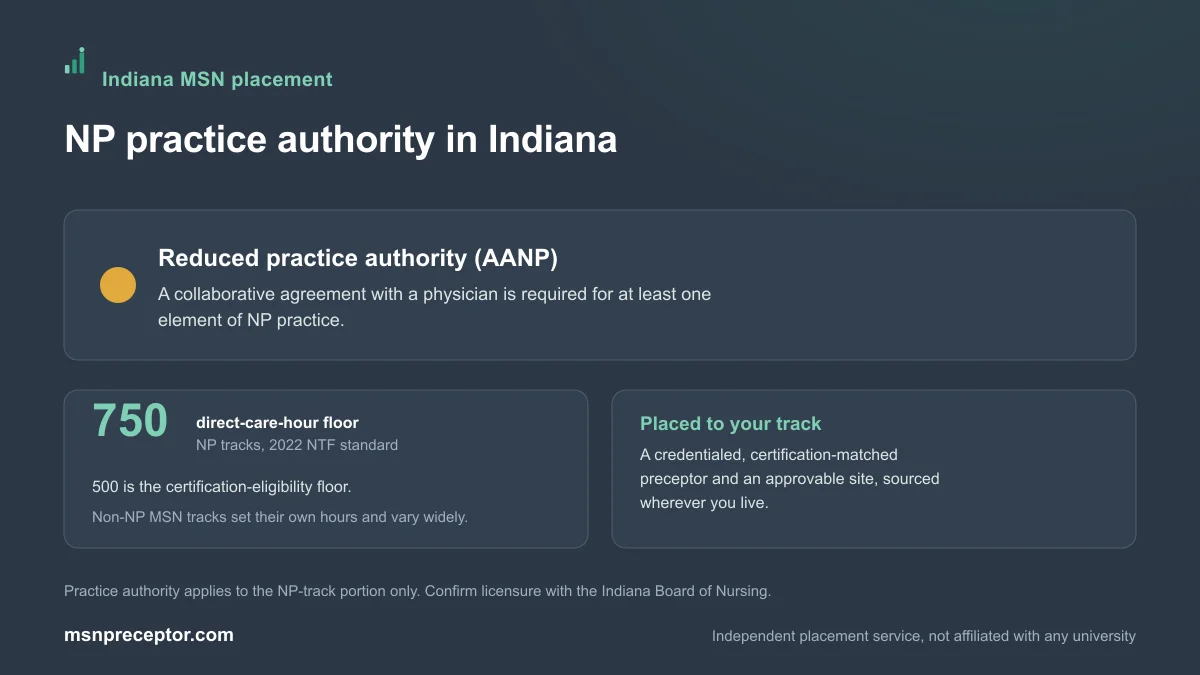
Your MSN practicum in Indiana depends first on your track. Nurse practitioner students need a licensed direct-care preceptor, while educator, informatics, and leadership students need a seasoned mentor in that role, and the two follow different maps across the state. Indiana is a reduced practice authority state, so for NP students a written collaborative agreement with a physician is generally part of the arrangement.
A Master of Science in Nursing leads to very different day-to-day work depending on the track, and we place across the whole set in Indiana instead of a single specialty. Nurse practitioner students are the largest group, but educator, informatics, and leadership students often have the hardest time finding a site on their own, so they get real attention here. See MSN specialties for how the tracks compare.
Indiana's health-system weight sits heaviest in Indianapolis, home to the largest systems and the analytics, informatics, and nurse-executive offices that come with them. For informatics and leadership practicums, the capital is the surest bet, with Fort Wayne in the northeast a strong second. Both metros also host schools of nursing and community college programs that support educator practicum.
Beyond those two, Evansville in the southwest, South Bend and Elkhart in the north, Bloomington, Lafayette, and the northwest counties near the Chicago line each anchor their own clinical markets. Nurse practitioner direct-care sites are spread across all of them, which helps family and adult-gerontology hours in particular, since a smaller-town clinic often sees the full range of patients. Pediatric, women's health, and psychiatric-mental health sites, along with non-NP mentor roles, thin out away from the metros, so plan around where you live and tell us if you can travel for a focused block.
AANP lists Indiana in the reduced practice category. Licensing runs through the Indiana State Board of Nursing under the Professional Licensing Agency. For a nurse practitioner, this generally means practicing under a written collaborative practice agreement with a licensed physician, so a student's preceptor often works within that structure. Indiana has seen active legislation that would remove the agreement requirement, but until a change is enacted, treat the collaborative model as current and confirm the details with the board.
For your placement, the practical effect is that many NP preceptors here practice alongside a collaborating physician, which can add a step to the paperwork. Any qualified preceptor works as long as they hold a current Indiana license and practice in your population. For educator, informatics, and leadership students, the practice category has little bearing, because the mentor is an experienced professional in that role rather than a prescriber.
Your hour requirement follows your track and your program, not the state line. Nurse practitioner tracks follow the 2022 NTF Standards, which recommend a minimum of 750 direct patient-care hours, while AANP and ANCC certification eligibility requires at least 500 faculty-supervised hours. Published NP totals commonly fall between roughly 500 and 750 or more, and many sit below 750, so do not assume a single number.
The non-NP tracks are lighter, with educator, informatics, leadership, and clinical nurse leader practicums commonly running about 100 to 200 hours, set by each program. Simulation is excluded from direct-care totals. Confirm your own figure in your handbook. MSN clinical hours explains how programs divide the total, and hours by school compares published NP numbers.
The reliable placements in Indiana, an open informatics seat in Indianapolis, a rural family-practice preceptor, a women's health block, tend to go to students who ask first. Add school review on top of the search, and the reduced-practice paperwork on many NP arrangements, and four to six months of lead time is sensible, with more for the narrow tracks.
We are independent, we work with MSN students at any university and in every track, and we handle the outreach, matching, and affiliation paperwork so the search is not one more thing between your shifts. We do not guarantee placement or your school's approval of any preceptor or site, because that decision belongs to your program. To begin, use the form at #match or reach us through contact, and how it works lays out the steps.
Yes. AANP classifies Indiana as reduced practice, so an NP generally works under a written collaborative agreement with a physician. Legislation to change that has been introduced, but until it is enacted the collaborative model stands. Confirm with the Indiana State Board of Nursing.
Mostly in the paperwork. Many NP preceptors here practice with a collaborating physician, which can add a step to the affiliation process. Any qualified, Indiana-licensed preceptor practicing in your population can still take you on.
Yes. We match educator, informatics, leadership, and clinical nurse leader students with a mentor in that role. Those placements cluster in Indianapolis and Fort Wayne, where the large systems and nursing schools are concentrated.
It depends on your track. Nurse practitioner tracks run into the hundreds of direct-care hours, while educator, informatics, and leadership tracks are far shorter. Your program handbook has the exact total, so confirm it there.
Often yes, especially for family and adult-gerontology hours, since smaller-town clinics see a wide range of patients. Narrow specialties and non-NP mentor roles are thinner outside the metros, so start early and let us know if you can travel.
No cost to request. An advisor reviews the current course, pathway, location, and approval requirements before candidate sourcing begins.
We do not guarantee placement. Final approval rests with your program.
