Illinois runs on two clinical geographies, the dense Chicago metro and a long downstate stretch, and your MSN track decides which one fits. Nurse practitioner students need a direct-care preceptor, while educator, informatics, and leadership students need an experienced mentor in that role. Illinois is a reduced practice authority state, so for NP students a collaborating physician is usually part of the arrangement, at least until a nurse practitioner qualifies for the state's independent-practice pathway.
A Master of Science in Nursing covers many roles, and we place across all of them in Illinois rather than one specialty. Nurse practitioner students are the majority, but educator, informatics, and leadership students need just as much help, since their sites are different and often harder to find. The deep specialty-by-state work lives on our sibling desks; this page stays wide. See MSN specialties.
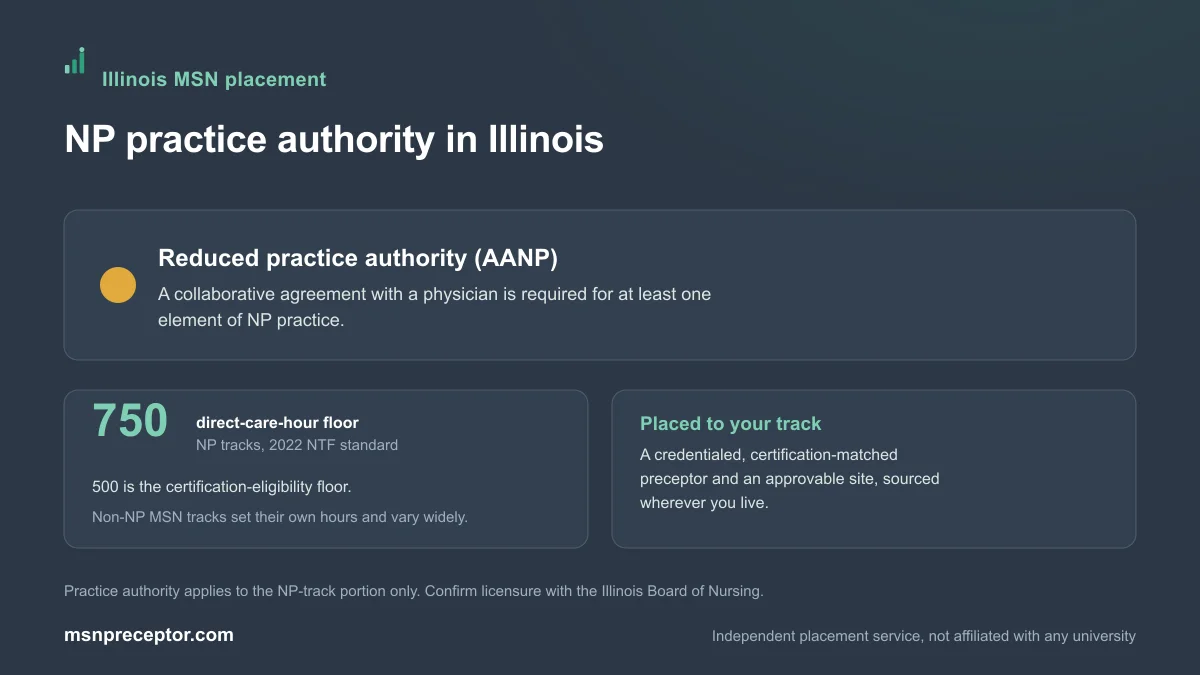
AANP lists Illinois in the reduced practice category. Licensing runs through the Illinois Department of Financial and Professional Regulation and its Board of Nursing. In practice this means a nurse practitioner student's preceptor usually works under a written collaborative agreement with a physician, so your supervision arrangement often reflects that structure.
Illinois also offers a full-practice-authority status that a nurse practitioner can earn after a set amount of clinical experience, commonly cited as at least 4,000 hours plus additional education, after which the written collaboration is no longer required. For you as a student, that means some preceptors practice independently and some under collaboration, and either can work as long as they hold a current Illinois license and practice in your population. Confirm the current rules on the department's own site. For educator, informatics, and leadership students, practice authority is largely beside the point, because the mentor is not prescribing.
The Chicago metro, Cook County plus the collar counties of DuPage, Lake, Will, Kane, and McHenry, holds most of the state's clinical and health-system capacity. For informatics and leadership students this is the center of gravity, since the large systems that run analytics teams and employ nurse executives are concentrated there. Nurse-educator practicum also has the most options in the metro, with many schools of nursing and community college programs to work with.
Downstate changes the math. Springfield, Peoria, Rockford, Champaign-Urbana, the Quad Cities, the Metro East near St. Louis, and Carbondale each anchor their own smaller clinical markets. Nurse practitioner direct-care sites are spread across all of it, which helps family and adult-gerontology hours, while pediatric, women's health, and psychiatric-mental health sites, along with non-NP mentor roles, are thinner the further you are from a metro. If you are downstate and can travel for a focused block, say so early.
Your hour total comes from your track and your program, not from Illinois. Nurse practitioner tracks follow the 2022 NTF Standards, which recommend a minimum of 750 direct patient-care hours, while AANP and ANCC certification eligibility requires at least 500 faculty-supervised hours. Published NP totals commonly range from roughly 500 to 750 or more, and many sit below 750, so verify your own instead of assuming a single figure.
Non-NP tracks are much lighter, with educator, informatics, leadership, and clinical nurse leader practicums commonly running about 100 to 200 hours, set by each program. Simulation is excluded from direct-care totals. Read your handbook for the real number. MSN clinical hours covers how totals are split, and hours by school compares published NP figures.
Illinois has a lot of sites, but the good ones fill, and school review takes weeks on top of the search. Because reduced practice adds a collaborating-physician layer to many NP arrangements, files here can take longer to assemble than in full-practice states. Four to six months of lead time keeps a term realistic, and more helps for the narrow specialties or a downstate placement.
We are independent, we work with MSN students at any university and across every track, and we handle the outreach, matching, and affiliation paperwork so you are not calling clinics between shifts. We never guarantee placement or your program's approval of a preceptor or site, since that decision is the school's. To start, use the form at #match or contact us through contact, and how it works walks through the process.
AANP classifies Illinois as reduced practice, so many NP preceptors work under a written collaborative agreement with a physician. Illinois does offer an independent-practice status after a set amount of experience. Confirm the current rules with the state licensing department.
It adds a collaborating-physician layer to many arrangements, which can lengthen the paperwork, but plenty of Illinois preceptors take students every term. Starting early is the main thing that keeps your timeline on track.
Yes. We match educator, informatics, leadership, and clinical nurse leader students with a mentor in that role. Those placements are most plentiful in the Chicago metro, where the large health systems and many nursing schools sit.
It depends on your track, not the state. Nurse practitioner tracks run into the hundreds of direct-care hours, while educator, informatics, and leadership tracks are far shorter. Confirm the exact number in your program handbook.
Many programs allow more than one site, which can help you reach a focused pediatrics or women's health block. Get any multi-site plan approved in writing first, and plan travel around a short intensive rather than a weekly commute.
No cost to request. An advisor reviews the current course, pathway, location, and approval requirements before candidate sourcing begins.
We do not guarantee placement. Final approval rests with your program.
