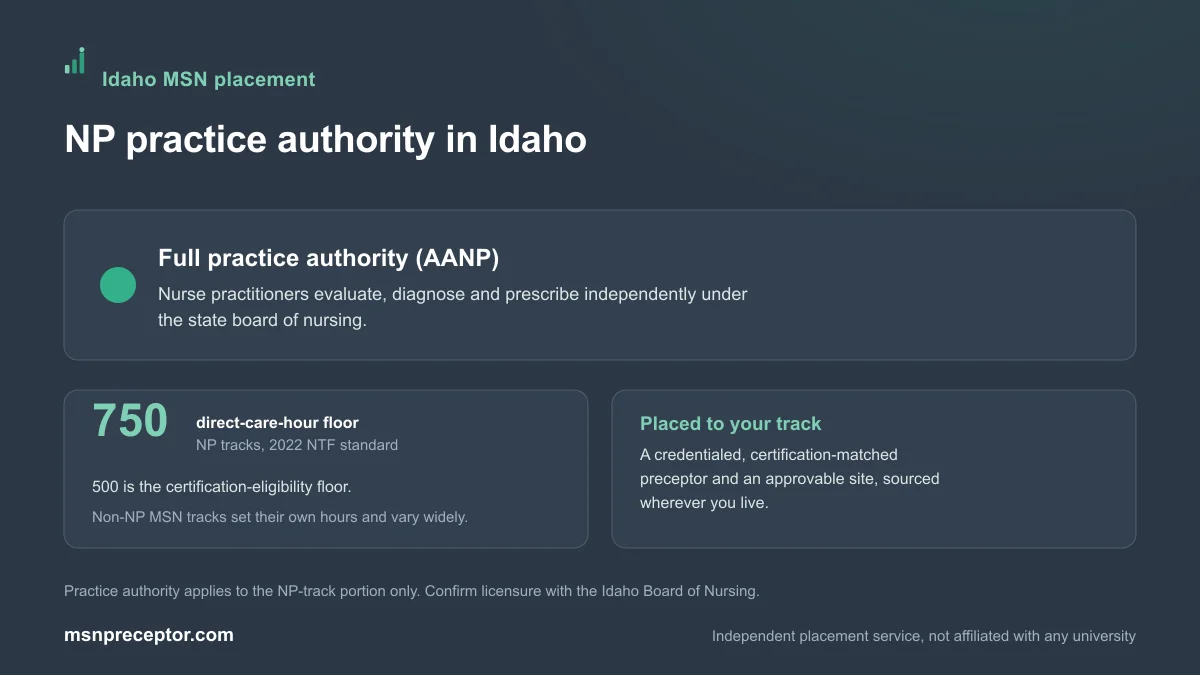
Idaho is a full practice authority state, which means an experienced nurse practitioner can precept an NP student on their own license, without a physician written into the arrangement. The bigger variable here is distance. Most of the state's health systems, informatics teams, and nurse-executive offices sit in a few metros, while nurse practitioner direct-care sites reach into small towns and frontier counties that see very few students.
The Master of Science in Nursing spreads across many roles, and we place the full width of them in Idaho rather than a single specialty. Nurse practitioner students make up most of the demand, but the non-NP tracks need real attention too, because their sites are different and often scarcer. Our specialty desks handle the deep NP-by-state work; this page stays broad. MSN specialties lays out the differences.
Idaho's population and its health systems concentrate in the Treasure Valley, the Boise, Meridian, Nampa, and Caldwell corridor. That is where the large multi-hospital systems, their analytics and informatics teams, and their nurse-executive offices sit, so informatics and leadership practicums are easiest to arrange there. Smaller concentrations exist around Idaho Falls and Pocatello in the east, Twin Falls in the south, and Coeur d'Alene in the north, which leans toward the Spokane market across the Washington line.
Nurse practitioner direct-care sites reach much further, into the small towns and frontier counties that make up most of Idaho's map. That breadth is an advantage for family and adult-gerontology hours, since a rural clinic may be the only care for a wide area and sees the full range of patients. It works against the narrow tracks: psychiatric-mental health, pediatric, and women's health sites thin out quickly outside the metros. Educator practicum follows the nursing schools, which sit mostly in Boise, Pocatello, the Lewiston area, and a handful of community colleges.
AANP lists Idaho in the full practice category. Licensing runs through the Idaho Board of Nursing, part of the Division of Occupational and Professional Licenses. Prescriptive authority, including controlled substances, is part of APRN licensure, and continuing-education rules apply, so confirm the current details on the board's own site.
For an NP student, full practice authority means the supervision arrangement is usually simpler. A qualified NP can take you on under their own license, with no collaborating physician required by the state, though your program can still set its own conditions. Your preceptor must hold a current Idaho license and practice in the population you are logging. For educator, informatics, and leadership students, the practice category matters little, because the mentor is an experienced professional in that role rather than a prescriber.
The number comes from your track and your program, not from the state. Nurse practitioner tracks follow the 2022 NTF Standards, which recommend a minimum of 750 direct patient-care hours, while AANP and ANCC certification eligibility requires at least 500 faculty-supervised hours. Published NP totals commonly land between roughly 500 and 750 or more, and plenty sit below 750, so confirm your own rather than assuming.
Non-NP tracks are much lighter, with educator, informatics, leadership, and clinical nurse leader practicums commonly running about 100 to 200 hours. Simulation does not count toward direct-care totals. Your handbook is the authority. MSN clinical hours shows how programs divide the total, and hours by school compares published figures.
In a state this spread out, starting early is the difference between a placement and a missed term. Rural direct-care preceptors are often willing but few, and a single informatics or nurse-executive mentor in a metro may have room for only one student a term. Four to six months of lead time is reasonable, and more helps for the narrow specialties or anything outside the Treasure Valley.
We are independent, we work with MSN students at any university and in every track, and we do the outreach, matching, and affiliation paperwork so you are not cold-calling clinics between shifts. We do not guarantee placement or your school's sign-off on any preceptor or site, because that call is your program's. To start, use the form at #match or reach us through contact, and see how it works for the steps.
Yes. AANP classifies Idaho as full practice, so a qualified NP can precept under their own license with no state-required collaborating physician. Programs can add their own rules, and you should confirm licensure details with the Idaho Board of Nursing.
Yes. We match educator, informatics, leadership, and clinical nurse leader students with a mentor in that role. In Idaho those placements cluster in the Treasure Valley and the other metros, where the health systems and nursing schools sit.
Often yes for the family and adult-gerontology tracks, since a rural clinic may see the full range of patients. Narrow tracks and non-NP mentor roles are thinner outside the metros, so start early and tell us if you can travel.
It depends on your track. Nurse practitioner tracks run into the hundreds of direct-care hours, while educator, informatics, and leadership tracks are far shorter. Check your program handbook for the exact number.
Many programs accept a physician for direct-care hours as long as they hold a current Idaho license and practice in your population. Your school sets that policy, so verify it before you rely on it.
No cost to request. An advisor reviews the current course, pathway, location, and approval requirements before candidate sourcing begins.
We do not guarantee placement. Final approval rests with your program.
