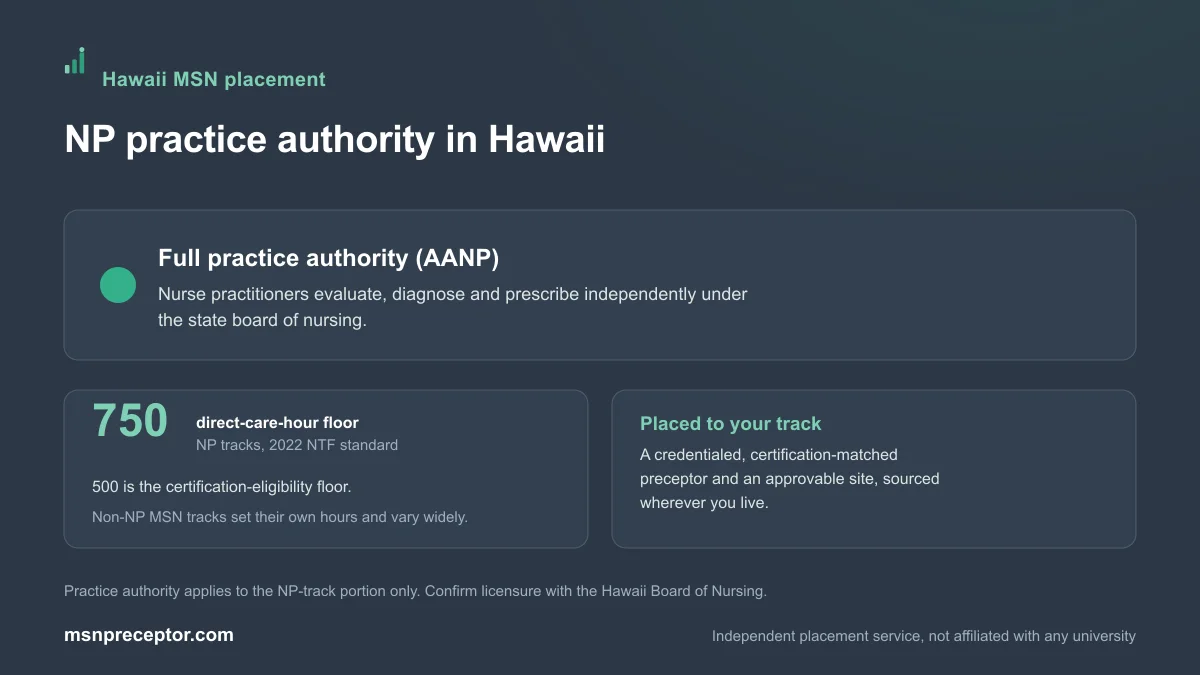
An MSN practicum in Hawaii looks very different depending on your track. Nurse practitioner students need a licensed direct-care preceptor, while educator, informatics, and leadership students need an experienced mentor in that role, and those settings cluster in different parts of the state. Hawaii grants nurse practitioners full practice authority, so the supervision question is usually simpler here than the geography.
The Master of Science in Nursing is one degree with many destinations, and each one asks for a different kind of practicum site. We match students across the whole range rather than a single specialty, because our sibling desks already carry the deep specialty work. See MSN specialties for how the tracks differ.
Hawaii's clinical density is not spread evenly, and that shapes every track differently. Oahu holds the large majority of residents and nearly all of the health-system infrastructure, from the Honolulu urban core to Kapolei and the Ewa plain, Pearl City and Aiea, Kailua and Kaneohe, and the Waianae coast.
For informatics and leadership students, Oahu is effectively the whole map. The multi-hospital systems that run analytics teams and employ nurse executives are anchored there, so a practicum shadowing a nursing operations leader or a clinical-systems team almost always means Honolulu. Educator practicum follows the schools of nursing and community college programs, which sit on Oahu and in a few neighbor-island towns. Nurse practitioner direct-care sites are the most widely spread, reaching Hilo and Kona on Hawaii Island, Kahului and the Kihei corridor on Maui, Molokai and Lanai, and Lihue on Kauai.
So plan around the island you live on. A weekly inter-island practicum day is fragile, because a site eighty miles away is a flight and not a drive. If you can relocate for a term, tell us early, because it widens the list a great deal.
AANP places Hawaii in the full practice category. Licensing sits with the Hawaii Board of Nursing, housed in the Department of Commerce and Consumer Affairs, which licenses RNs and APRNs, with prescriptive authority handled as part of APRN licensure. Confirm current requirements on the board's own site, since these details change faster than summary pages get updated.
For a nurse practitioner student, full practice authority mostly changes structure. An experienced NP can precept you under their own license, with no collaborating physician written into the arrangement the way reduced-practice states require. The baseline does not move: your preceptor holds a current Hawaii license and practices in the population you are logging. For the non-NP tracks, practice authority matters less, because your mentor is an educator, an informaticist, or a nurse executive rather than a prescriber.
Hours attach to your track, not to Hawaii, and the gap between tracks is wide. For nurse practitioner tracks, the 2022 NTF Standards recommend a minimum of 750 direct patient-care hours, while AANP and ANCC certification eligibility requires at least 500 faculty-supervised hours. Accredited NP programs commonly publish totals from roughly 500 to 750 or more, and many sit below 750, so do not assume yours is any single number.
The non-NP tracks carry far less. Educator, informatics, leadership, and clinical nurse leader practicums commonly run in the range of roughly 100 to 200 hours, set by each program. Simulation is excluded from direct-care totals. Open your handbook, find your real number, and build around it. MSN clinical hours explains how totals get divided, and hours by school compares published NP totals.
Lead time is the best predictor of a smooth Hawaii placement, especially for scarce settings like a neighbor-island direct-care site or an informatics team with only a seat or two open. Four to six months ahead of your term is not early here. Have your affiliation-agreement process, preceptor or mentor requirements, hour total, and term dates ready before you ask, because the right person wants all of it in the first conversation.
That is where we come in. We are independent, we work with MSN students at any university and in any track, and we handle the outreach, matching, and paperwork chase so you are not calling sites between shifts. We never guarantee placement or your school's approval of a preceptor or site, since that decision belongs to your program. If you want us searching, use the form at #match or reach us through contact. How it works covers the steps, and cost is upfront.
Structurally, yes. Hawaii's full practice classification means a qualified NP can practice and precept under their own license, with no collaborating physician required by the state. Your school can still add conditions, so read your handbook first.
Yes. We match nurse educator, informatics, leadership, and clinical nurse leader students with an experienced mentor in that role. In Hawaii those sites cluster on Oahu, in the schools of nursing and the larger health systems. See MSN specialties.
Most programs allow more than one site, and a short focused block on another island can work when you fly to it. A weekly inter-island commute rarely holds up. Get any multi-site plan approved in writing before you commit.
It depends on your track, not the state. Nurse practitioner tracks run into the hundreds of direct-care hours, while educator, informatics, and leadership tracks carry far fewer. Confirm the exact total in your own program handbook.
No. We are independent and place MSN students from any university across every track. School names, when they come up, are used only to describe a program, never to imply we act for it.
No cost to request. An advisor reviews the current course, pathway, location, and approval requirements before candidate sourcing begins.
We do not guarantee placement. Final approval rests with your program.
