MSN practicum requirements vary by pathway and program. Confirm the current course before sourcing a preceptor, mentor, or site.
Connecticut placement

Where Connecticut MSN students find a practicum match

Yes, we match MSN students across Connecticut to a preceptor or practicum mentor, whatever your track. MSN is one degree with several paths, so the search for a nurse practitioner headed into direct patient care looks nothing like the search for a nurse educator, informaticist, or future nurse leader. This page shows how each of those placements works in Connecticut, from the Hartford and New Haven cores to the quieter eastern shoreline.

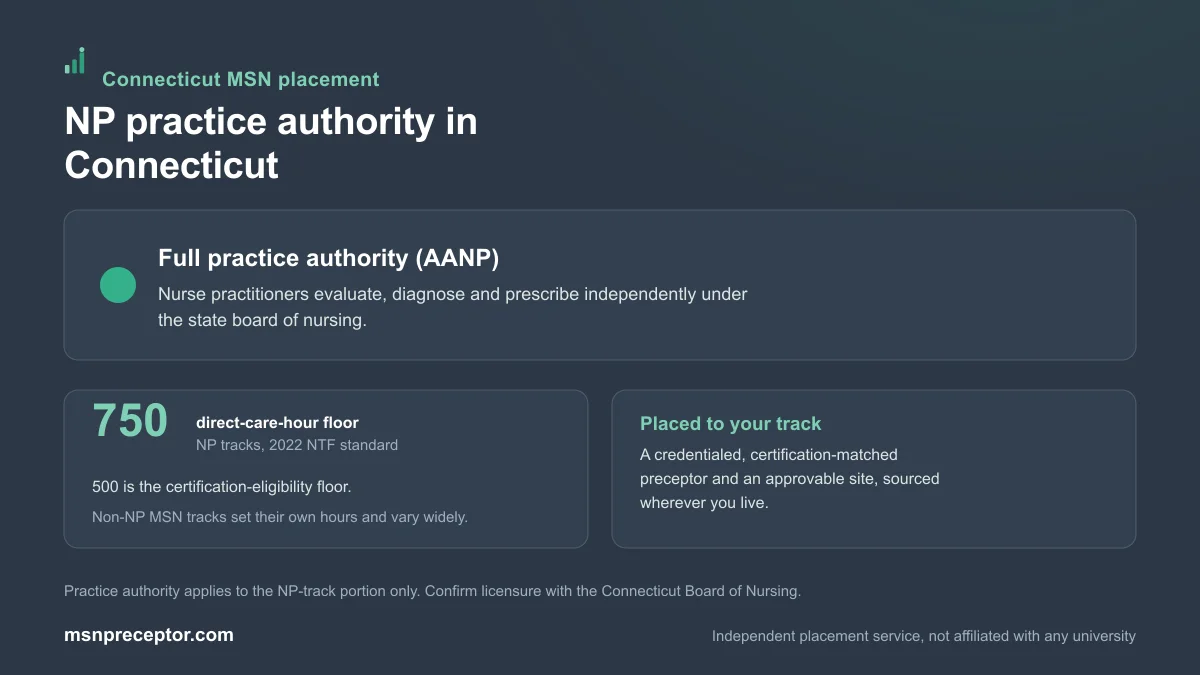
NP practice authority in Connecticut: Full practice authority (AANP), on the 750-hour NP direct-care floor with non-NP MSN tracks varying
Connecticut: Full practice authority (AANP). NP tracks anchor to the 750-hour direct-care floor; non-NP tracks vary.

The MSN is one degree with many practicum needs

Master of Science in Nursing covers a spread of tracks, and the practicum you need is set by which one you chose, not by the letters MSN alone. Across Connecticut we place students in both halves of that spread.

  • Nurse practitioner tracks that require a direct patient-care preceptor licensed in Connecticut: family, psychiatric-mental health, adult-gerontology primary and acute care, pediatric, women's health, and neonatal.
  • Non-NP tracks that require a role-matched mentor rather than a prescriber: nurse educator, nursing informatics, health-systems leadership or administration, clinical nurse leader, and public or community health.

Sorting your track first is what keeps the search efficient. Our MSN specialties page breaks down each one.

Connecticut practice authority and your preceptor

Connecticut is a full practice authority state, reached through a transition-to-practice model. A new NP works under a written collaboration with a physician for a set early period, then practices independently after meeting the state's experience threshold.

  • Most experienced NPs you would want as a preceptor are already past that early window and practicing independently, which widens your pool.
  • A newer NP may still be inside the collaborative period, which is fine for precepting as long as your program accepts it.
  • The category sets the supervision frame; your program still decides who qualifies and how hours count.

Confirm current rules with the Connecticut Board of Examiners for Nursing before you finalize anything, since the details shift.

Non-NP tracks and where Connecticut supports them

These are the tracks specialty placement sites ignore, and Connecticut's density of health systems and colleges makes them workable. The mentor is a practicing professional in the role, and the hours are lighter.

  • Nurse educator: practicum in a school of nursing, a hospital staff-development unit, or a clinical-education team, found across the state wherever nursing is taught.
  • Nursing informatics: a seat with a health-system IT, analytics, or clinical-systems group, clustered around Hartford, New Haven, and lower Fairfield County.
  • Leadership or administration: a rotation alongside a nurse executive at a hospital or system office.
  • Clinical nurse leader and public health: unit-level coordination roles or a placement with a municipal or state health agency.

These mentors are specialized and fewer in number, so an early start matters more here than for primary-care NP work.

Where Connecticut placements concentrate

The state is compact, but the clinical supply still bunches in predictable places.

  • The Hartford capital region and the New Haven area hold the largest health systems, and with them most of the informatics, analytics, and leadership placements.
  • Lower Fairfield County, around Stamford and Bridgeport, adds corporate healthcare offices useful for leadership and informatics tracks.
  • Eastern Connecticut, from Norwich toward the shoreline, is quieter, so some NP specialties there take longer to source.

When your town runs short in your specialty, we widen the radius early rather than let a term slip.

Your hours follow your track

Connecticut does not set your practicum total; your track and your program do.

  • NP tracks are the heaviest. The 2022 National Task Force standards recommend at least 750 direct patient-care hours, certification eligibility requires a minimum of 500 faculty-supervised hours, and accredited programs commonly publish somewhere around 500 to 750 or more, many of them under 750.
  • Educator, informatics, leadership, and clinical nurse leader tracks usually carry far fewer, often roughly 100 to 200 practicum hours by program design.
  • Simulation hours are excluded from the direct-care minimum.

Read your syllabus for the exact figure, and our MSN clinical hours page explains the standards behind it.

How we line up your Connecticut match

We are independent and place students from any university, so we build the search around your track and your Connecticut deadlines, not one school's contacts.

  • Send your track, your required hours, and your part of the state, and we scope sites that can realistically say yes.
  • We reach out to preceptors and mentors, verify license and role fit, and give your program a clean packet to review.
  • Nothing is billed until a match is confirmed and your school approves. See how it works and cost.

When you are ready, request a preceptor at the match form and we answer within one business day. We help with sourcing and coordination and never guarantee placement or a program's approval.

Questions

Frequently asked

Is this only for family or psych NP students in Connecticut?

No. We place every MSN track in Connecticut. NP students are the biggest group because their tracks demand direct patient-care hours, but we also match educator, informatics, leadership, clinical nurse leader, and public-health students with a suitable mentor.

Connecticut has full practice authority, so do I still need a preceptor?

Yes. Practice authority governs licensed NPs at work, not students in a program. You still complete supervised clinical hours with an approved preceptor. The transition-to-practice rule mainly affects newer NPs, not your requirement to have one.

How many practicum hours does Connecticut require?

The state does not set the number; your track and program do. NP tracks run into the hundreds of direct-care hours, anchored by a 2022 recommendation of at least 750 and a 500-hour certification floor, while non-NP tracks are usually much lighter. Confirm your total with your program.

My program is based in another state. Can I still place in Connecticut?

Yes. We are not tied to any university, so we frequently arrange Connecticut practicum for students enrolled elsewhere. We match to your track and your program's rules, then send your school a packet to approve. Compare programs on our hours by school guide.

Request a preceptor

Tell us your MSN pathway. We'll start sourcing.

No cost to request. An advisor reviews the current course, pathway, location, and approval requirements before candidate sourcing begins.

We do not guarantee placement. Final approval rests with your program.