We help Master of Science in Nursing students throughout Arkansas find the practicum their program requires, from a direct patient care preceptor for a nurse practitioner track to a qualified mentor for education, informatics, leadership, or public health. The MSN covers many roles, so the right site depends on your specialty and your location, not on which school enrolled you. Our desk is independent, open to students at any university, and it helps first and never guarantees a placement or a program's approval.
The Master of Science in Nursing leads to very different roles, and the preceptor you need depends on which one you are pursuing. A nurse practitioner student lives in direct patient care, while an informatics or leadership student works next to a team that manages systems or people. In Arkansas we place the full set of tracks:
Once we know your track and hours, the search narrows quickly, and the settings we approach differ completely from one track to the next.
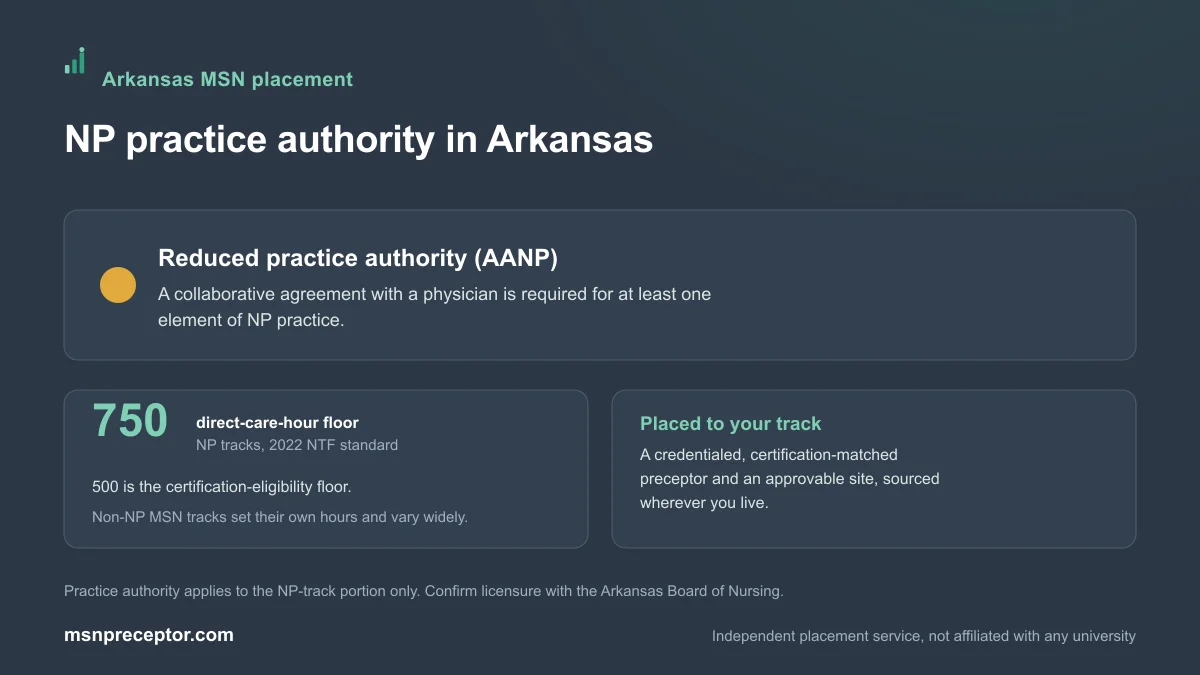
Arkansas is a reduced practice state under the American Association of Nurse Practitioners classification. A nurse practitioner with prescriptive authority keeps a current collaborative practice agreement on file with the state board, which sets the supervising structure at a nurse practitioner site. The state also has a pathway, opened in recent years, that lets experienced nurse practitioners apply for independent practice after several thousand hours worked under such an agreement.
For a student, this mostly shapes who can supervise you and how the site documents that relationship. It does not change the number of hours your program requires, and it rarely touches non clinical tracks like educator or informatics. Rules evolve, so confirm the current requirements with the Arkansas State Board of Nursing before you count on them.
There is no universal hours figure. Nurse practitioner tracks require direct patient care, and the 2022 National Task Force standards recommend a minimum of 750 hours, while national certification generally requires at least 500 faculty supervised hours, and accredited programs commonly publish totals between roughly 500 and 750 or more. Simulation does not count toward these clinical hours.
Educator, informatics, leadership, and clinical nurse leader tracks carry far fewer, commonly in the range of about 100 to 200 practicum hours completed with a mentor rather than a prescriber. Since the spread is wide, confirm your own program's requirement before scheduling. Our MSN clinical hours page explains how these totals are set.
Non practitioner tracks are frequently the hardest to place, because specialty preceptor services do not cover them, and they are central to our work. A nurse educator student is matched with a faculty member or staff development leader inside a school of nursing or a hospital education unit. An informatics student is placed with a clinical systems or analytics team. A leadership student shadows a chief nursing officer, a nursing director, or an operations leader, and a clinical nurse leader student works with a unit based leader.
These mentors are experienced nurses in the role, not prescribers, and their hours are lighter. What limits them is usually geography, since informatics and executive functions gather in the larger health systems.
The central region around Little Rock holds the state's deepest pool of academic medicine, health system informatics, and nurse executive leadership, which is where non clinical practicum most often lands. Northwest Arkansas around Fayetteville and Springdale is a fast growing second hub, and Jonesboro in the northeast, along with Fort Smith, Pine Bluff, Texarkana, and El Dorado, extend regional hospital and education options.
Direct patient care sites for nurse practitioner students reach across the whole state, including the Delta and the rural south, but preceptor supply tightens the farther you are from a hospital hub. Educator placements follow the universities and community colleges. When a local match is scarce, our desk works the nearest regional center rather than leaving you to search alone.
We start with a short intake on your track, required hours, timeline, and county, then approach preceptors and sites that fit and confirm they can supervise a student in your specialty. Being independent lets us work for students at any university, including online programs based out of state. We help with the match and the paperwork, and we are straight with you that we cannot guarantee a site or your program's approval of a preceptor.
To get moving, share your rotation on our contact page, see how it works, or start at the match form.
Yes. Nurse educator, informatics, leadership, and clinical nurse leader placements are a core part of our work, matched to an experienced mentor in the role rather than a prescriber, in settings other services rarely reach.
For nurse practitioner tracks it means your preceptor supervises you within a collaborative agreement kept on file with the state board. It does not change your required hours and has little effect on non clinical tracks. Confirm current rules with the Arkansas State Board of Nursing.
It depends on the track. Nurse practitioner tracks commonly run from about 500 to 750 or more direct care hours, while educator, informatics, and leadership tracks often sit near 100 to 200. Verify the exact figure with your own program.
Yes. We are independent and place students at any university, including distance programs, as long as we can meet your school's preceptor and site criteria in Arkansas.
No. We work to find and confirm a suitable match and support the paperwork, but final approval rests with your program, and we never guarantee an outcome.
Last updated July 2026. Sources: Arkansas State Board of Nursing, Advanced Practice; Arkansas State Board of Nursing, Collaborative Practice; AANP State Practice Environment.
No cost to request. An advisor reviews the current course, pathway, location, and approval requirements before candidate sourcing begins.
We do not guarantee placement. Final approval rests with your program.
